Primary vs. Secondary Sources: What is the Difference?

In short

A primary source is firsthand material: letters, data, interviews, legislation. A secondary source interprets it, as a journal article does. The same document can be either, depending on your research question, and most papers need both. This guide covers the definitions, how to tell them apart, examples by discipline, and where each belongs in your paper.

Key takeaways

  • Primary sources are raw material; secondary sources interpret it.

  • The category depends on your research question, not on the document type or its age.

  • Three questions settle most cases: was it created at the time, by a participant or direct observer, and is it evidence or analysis?

  • What counts as primary varies by field: a novel in literature, a dataset in the sciences, an interview transcript in social research.

  • Tertiary sources such as encyclopedias are for background, not for citing as evidence.

  • Use primary sources as evidence and secondary sources as context, showing how your argument fits the existing conversation.

Sometimes, when you are deep into the paper, you suddenly come across an important requirement; it says “at least three primary sources,“ and the article you have opened is both peer-reviewed and published in a real journal, but you still don’t know whether it qualifies as a primary source or not. This is the point where the question of primary vs. secondary sources demands a clear explanation.

This confusion is not because of a gap in your reading; it is that no rule based on format alone can actually clear it. The same article can be a primary source in one paper and secondary in the other. That is why it is important to know the difference before using a source in your research. It will strengthen the credibility of your research paper.

In this guide, you’ll get a clear explanation of primary sources vs. secondary sources and complete checks and edge cases that trip students up while analyzing sources. This guide will tell you whether the source is credible or not and provide you with primary vs. secondary source examples for further clarity.

What is a Primary Source?

A primary source refers to the original information that is created by a person who experienced an event or directly participated in it. Neither is it summarized, interpreted, or explained by someone else. For example, it includes diaries, photographs, letters, interviews, original documents, and research data.

To be more clear, a primary source is a direct piece of evidence about a person, event, or topic. It lets you look at the original information yourself and come to your own conclusion. Furthermore, it does not necessarily mean that if it is a primary source, it is completely accurate and free of bias. That’s why you’ll always need to read it and analyze it critically before using it in your research.

What makes a source primary?

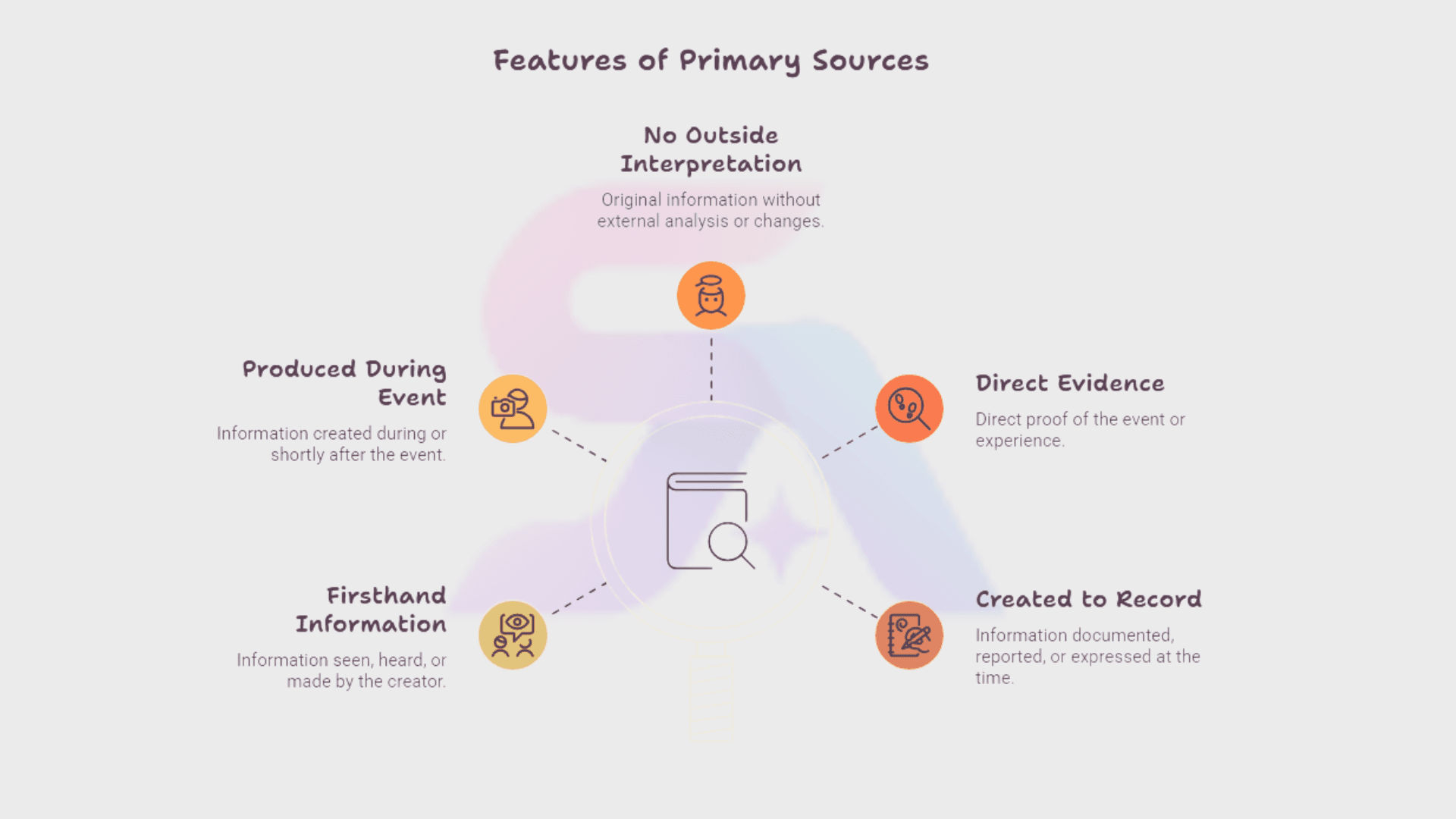
Primary sources share a number of important features. It includes 

  • Firsthand information: the information being recorded has been seen, heard, or made by the creator.

  • Produced during the event: most primary sources are produced during an event or shortly after it. Memoirs and autobiographies can be an exception, because they are written later but are still based on the writer’s own experience.

  • No outside interpretation: the original information has not been explained, analyzed, or changed by another person. Researchers can see the evidence themselves and draw their own conclusions.

  • Direct evidence: Primary sources give the researcher direct evidence of the event, experience, or information itself, rather than explaining someone else’s observation.

  • Created to record, not to explain: the purpose of a primary source is usually to document, report, or express something at the time, rather than to make sense of it afterwards.

Examples of primary sources by discipline

What counts as a primary source varies by discipline.

Discipline

Primary sources

History

Diaries, personal letters, speeches, photographs, government records from the period

Science

Raw research data, lab notes, clinical trial results, original empirical studies

Literature

The original works themselves, such as novels, poems, and plays

Law

Court transcripts, statutes, legal contracts, judicial opinions

Social sciences

Surveys, interview transcripts, census records, field notes

Media and communication

Newspapers published at the time, broadcasts, advertisements, social media posts

primary-vs-secondary-sources

What Is a Secondary Source? 

A secondary source is written by someone who was not part of an event or a witness to an event. It is not new evidence but an explanation, analyzis, or summary of information found in a primary source. For example, a photograph of a historical event is a primary source. A book explaining the photograph, the meaning of the photograph, and the significance of the event is a secondary source. 

Put, a secondary source does some of the analyzis for you; it does not give you the raw information. This is the core distinction of secondary vs. primary sources.

What makes a source secondary?

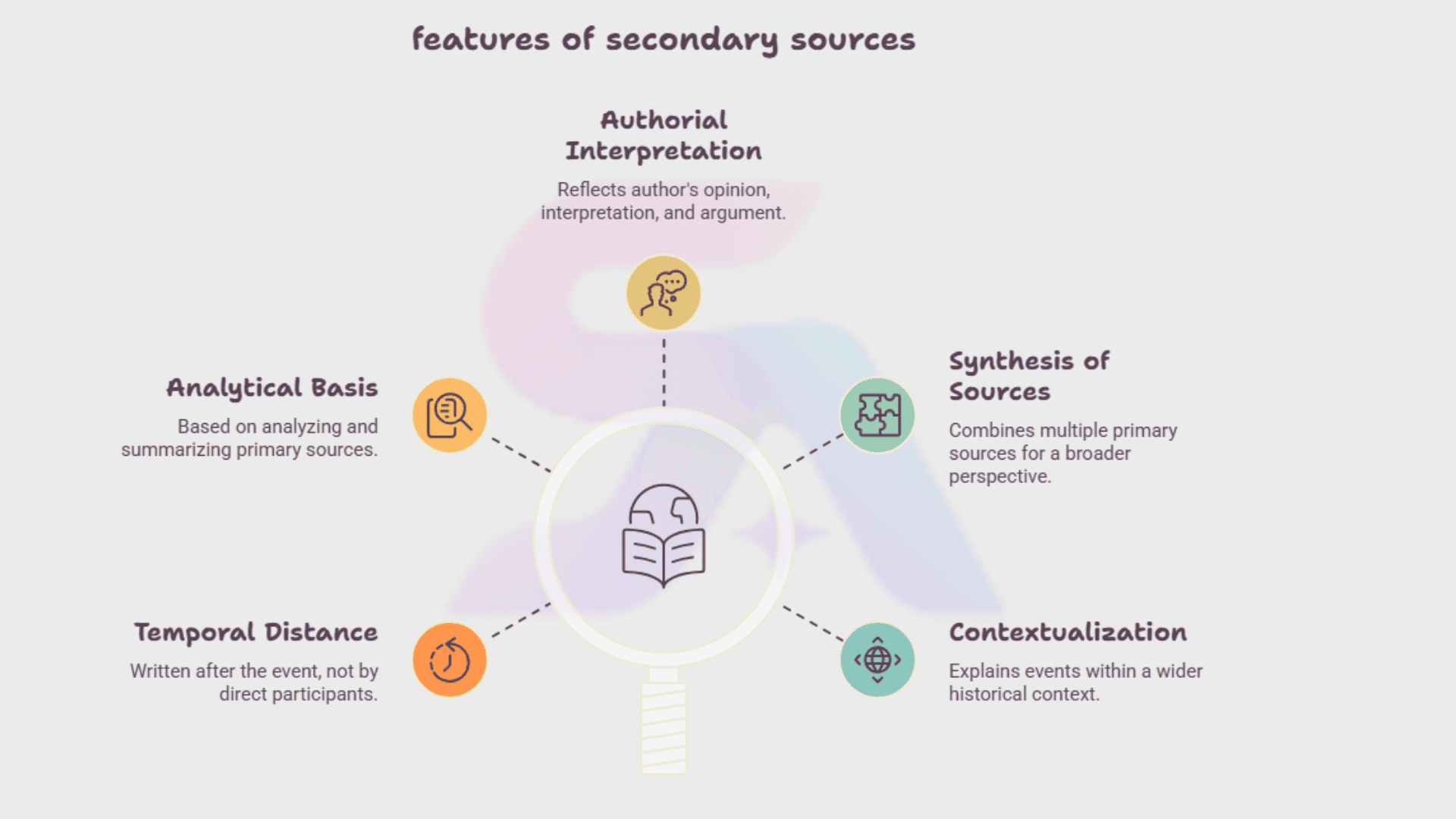
Secondary sources are generally

  • Written after the event and often by someone who was not there

  • Based on analyzing, explaining, or summarizing information from primary sources

  • Determined by the author’s own interpretation, opinion, or argument

  • Built from several primary sources at once, rather than explaining one single record. 

  • Created to help explain the information by putting it into a wider context and explain why it matters.

Examples of secondary sources by discipline  

Discipline

Secondary sources

History

Textbooks, biographies, documentaries, history books

Science

Literature reviews, meta-analyses, articles that summarize the results of many studies

Literature

Literary criticism, analytical essays, exhibition catalogues

Law

Legal commentary, case notes, treatises

General research

Review articles, academic commentary


A documentary about a historical event, for example, is a secondary source because it is made after the event and it uses primary sources such as photographs, documents, and interviews. However, the documentary also adds the creators' own explanation and interpretation of what happened. 

Key differences between primary and secondary sources

Factor

Primary source

Secondary source

Origin

Created by someone directly involved in the event

Created by a researcher, historian, or analyzt working from the record

Timing

During or shortly after the event

After the event, often years or decades later

Purpose

To record or document something as it happens

To explain, analyze, and give context to what happened

Information type

Original and unfiltered

Analyzed and summarized

Level of detail

Specific, granular, close to the event

Broader, drawing several sources together into one picture

Role in research

Direct evidence

Context and interpretation

Accessibility

Often harder to reach; many are rare, fragile, or held in a single archive.

Usually easier to reach through journals, books, and databases

Examples

Diaries, speeches, interviews, raw data

Textbooks, biographies, literature reviews

primary-source-vs-secondary-source

What about tertiary sources?

Understanding Primary vs secondary vs tertiary sourcesCan help you decide what a source is useful for and whether it belongs in your final evidence. 

Some sources are not categorized as either type. They are referred to as tertiary sources. They index, compile, or repackage the information that has already been gathered from primary or secondary sources. Tertiary sources barely contain original analysis; this is a mix of information gathered from several resources. Plus, they are not credited to a single author.

Examples include encyclopedias, bibliographies, dictionaries, databases, indexes, and many other general textbooks. 

Moreover, tertiary sources are only useful when you are still determining or analyzing the topic’s central idea and looking for keywords, key names, and further reading for better understanding. They are not cited as evidence in academic work. The information from these sources can be considered secondary if they follow the basic standards. For example, an encyclopedia entry written and signed by a named scholar is often treated as secondary, but if it is unsigned, it is a tertiary source. 

How to Tell If a Source Is Primary or Secondary

When you are not sure what type of source you have, think about these questions: 

  • Was it created during or soon after the event? Most likely a primary source. 

  • Does the author have first-hand experience or participation in the event? The author is writing about an event or topic that she or he did not have first-hand experience with. Probably a secondary source.

  • Does it analyze, summarize, or explain information from other sources? Probably a secondary source.

These three questions answer most of the primary source vs. secondary source decisions. One important rule is that content is more important than format. A newspaper article, for example, can be primary or secondary. An eyewitness account published on the same day as an event is a primary source, while an opinion piece written years later to discuss that event is a secondary source. 

When Can a Secondary Source Become a Primary Source?

A source is not always primary or secondary. It could be classified as something else, depending on your research and how you use the source. For instance, 

A documentary.A documentary on World War I is usually a secondary source because it was made long after the war by people who were not there. However, if your research is on how documentaries portray World War I, then the documentary in question is a primary source because it is the subject of your research.

A movie review. If you are investigating the historical accuracy of a film, then the review is a secondary source because it is someone else’s analysis of the film. But if you’re studying how critics received the movie when it first came out, the review is a primary source. The key point is you should classify a source by your research question and how you’re using it, not merely by its format.

Special cases that confuse students

Journal articles

This is the most common point of confusion, because journal articles can be either primary or secondary.

An article that reports original research is considered a primary source that includes empirical studies, experiments, clinical trials, or any type of research where the authors collected and reported their own data. However, the literature review that is published in the same article is the secondary source, as it summarizes and provides an analysis and understanding of others' work. That’s why understanding of primary vs. secondary data sources is essential while citing any source.

Moreover, if the article is peer-reviewed, it is not necessarily a primary source, and it can be either. To be clear, peer review gives the quality check and not the category it belongs to. So you have to look for it yourself to determine whether the data is generated by the authors directly or not.

Autobiographies and memoirs

These are primary sources because they are based on the writer’s own experience. But they are written long after the events they describe, so they are shaped by memory, hindsight, and the writer’s wish to present themselves in a particular way. Treat them as firsthand evidence that needs careful handling.

Interviews and oral histories

A transcript or recording of an interview is a primary source, whether you conducted it yourself or found it in an archive. If a researcher quotes selected parts of that interview inside an argument of their own, that article is a secondary source.

Translations and edited collections

A translated novel or a published collection of a writer’s letters is still treated as a primary source, but it has passed through an editor’s or translator’s hands. Note which edition you used, because the choices made in translation and selection can affect your analysis.

Websites and social media

There is no single answer. An organization’s own posts, statements, and pages are primary sources for research about that organization. A blog post summarizing a news story is a secondary source. Apply the three questions above rather than judging by the medium.

How to choose between primary and secondary sources

Knowing the difference is only half the job. The more practical question is which type to reach for at a given stage of a project. Five factors usually decide it.

What your research question needs. If you are making a claim about what happened, what was said, or what the data shows, you need primary sources, because that is the only kind of evidence that can settle the point. If you are positioning your work within a field, explaining why a debate exists, or establishing what is already known, secondary sources do that job better.

How well you know the topic. Starting with primary sources in an unfamiliar field is slow and often misleading, because you have no way of judging whether the document in front of you is typical or unusual. Read two or three good secondary sources first to learn the shape of the debate and the names that keep recurring, then go to the primary material with an idea of what you are looking for.

How much detail you need. A close reading, a discourse analysis, or an original data argument requires primary material. A background section, an introduction, or a short orientation piece rarely does.

How much time you have. Working through primary sources takes longer than it looks. Archival material may be uncatalogued, handwriting may be difficult, datasets may need cleaning, and none of it arrives pre-summarized. Secondary sources are written to be read quickly. Plan your schedule around that difference rather than discovering it a week before the deadline.

What you can actually get hold of. Check early whether the primary sources your question depends on are reachable, whether that means a digitized archive, a data repository, an interlibrary loan, or a visit. A question that requires material you cannot access is a question that needs reframing, and it is far cheaper to learn that in week one than in week six.

How to check that a source is credible

Neither category comes with a guarantee. Both need checking, but you check them for different things.

Evaluating a primary source

Because primary sources are firsthand, students sometimes treat them as straightforwardly true. They are evidence, not verdicts. Before you use one, ask who created it, why, and for what audience. Consider whose perspective the record leaves out, judge it against the standards of its own time, and corroborate it against other primary sources. 

Evaluating a secondary source

Here you are assessing someone else’s research process as much as their conclusions.

  • Authorship: Check the author’s credentials and any affiliation or funding that could shape the argument. 

  • Publication details.Look at the publisher and the date, since an older review may have been overtaken in a fast-moving field.

  • Peer review.For academic work, check whether the journal is peer reviewed. It has nothing to do with primary or secondary sources; it assures the credibility of sources.

  • Citations and references.Look at what it cites: work built on solid primary sources is more reliable than work that only cites other summaries. Spot-check two or three references against what the author claims they say. 

If a secondary source makes a claim that matters to your argument, follow it back to the primary source before you.

Where to Find Primary and Secondary Sources 

Knowing the difference between primary and secondary sources is helpful, but you also need to know where to find them. 

Where to Find Primary Sources

  • University and government archives 

  • Newspaper archives with original reports

  • Museum and library special collections

  • Oral history projects and recorded interviews

  • Official government records

 Where to Find Secondary Sources 

  • Peer-reviewed academic journals

  • Google Scholar and university library databases

  • Published books and textbooks 

  • Reliable news analysis and commentary 

Common mistakes that students make 

  • Thinking a Source is always primary or Secondary. Sources can fall into different categories based on your research question and how you are using them. 

  • Assuming Secondary Sources Are 100% Objective. Secondary sources include the author’s interpretation or point of view, so read critically rather than taking everything as fact. 

  • Using Only Secondary Sources. Good research usually contains both primary sources as direct evidence and secondary sources to provide context and analysis. 

  • Confusing the Format with the Category. because a source is a book, article, video, or other format doesn’t automatically make it a primary or secondary source.

Share this post

Related posts

Browse all posts