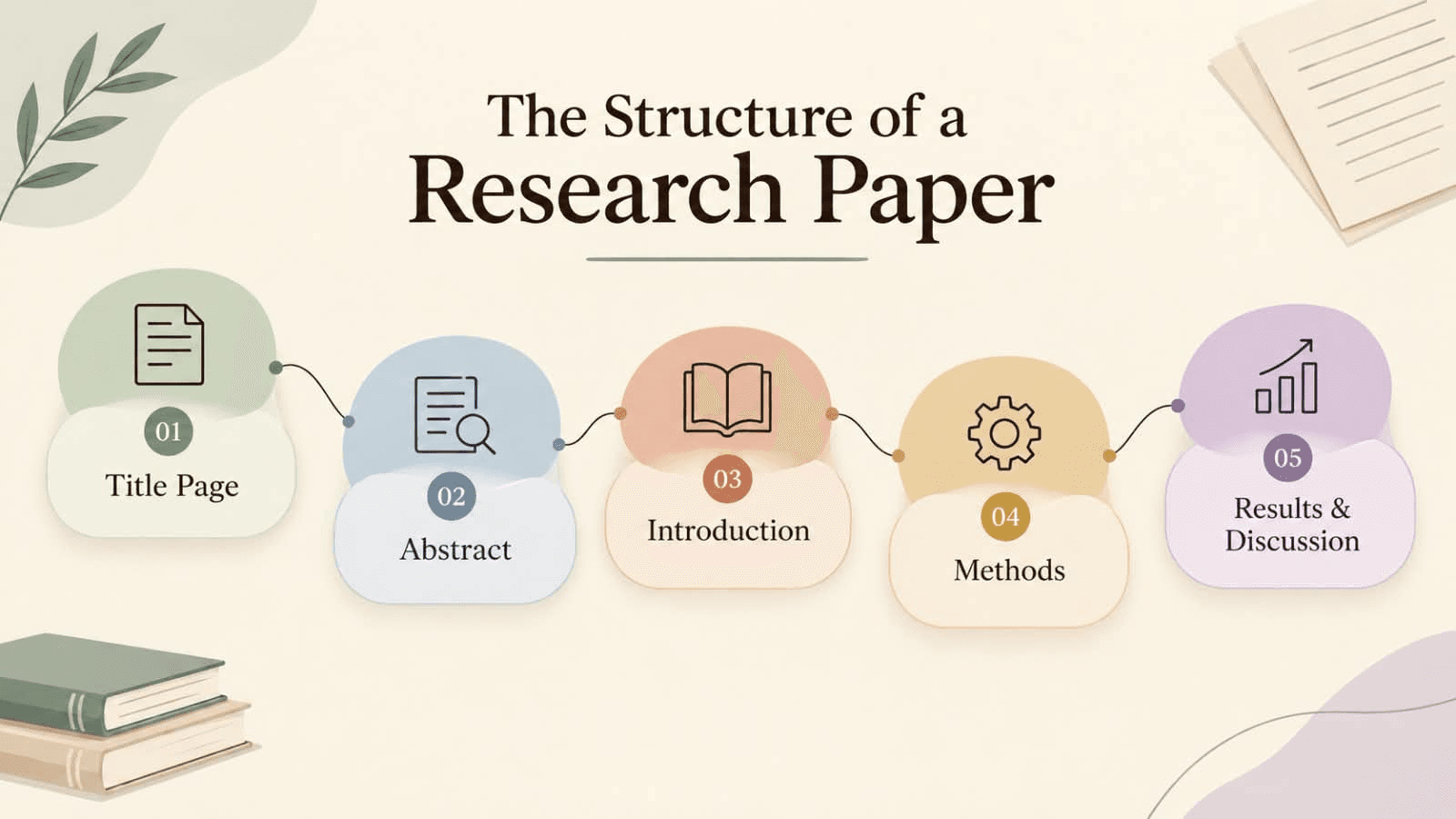
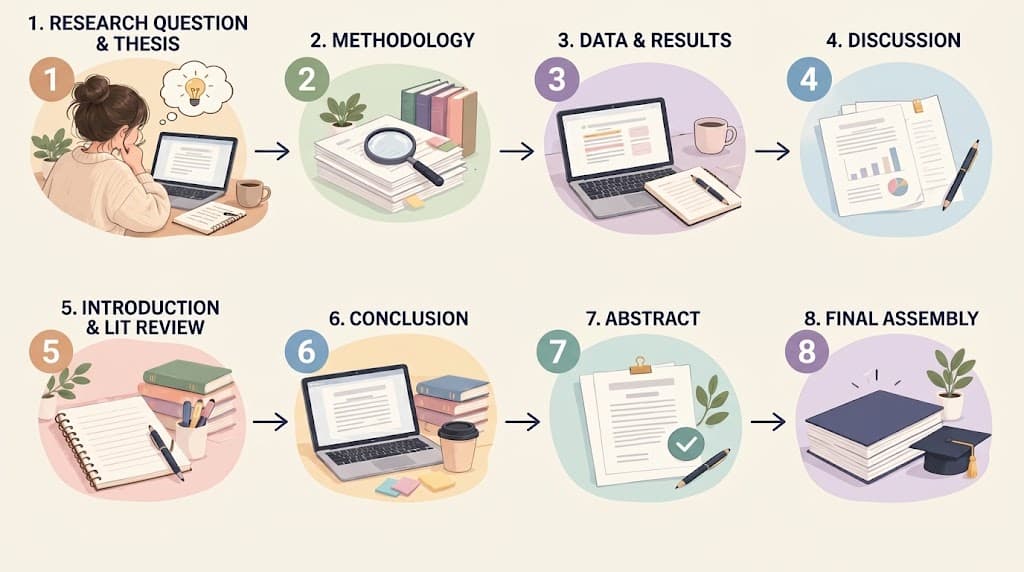
Before going to see each part separately, first of all, look over the structure of a research paper because it will be helpful. Mostly, educational research papers, irrespective of subject, are built from a combination of these components:
Title Page
Introduction
Literature Review
Methodology or Methods
Results
Discussion
Conclusion
References
Appendices (when needed)
Not all of the above parts are used in every paper, and sometimes in small papers some parts are combined. But this list covers all the components of a research paper that you face anytime in an educational setting, either in a first-year undergraduate assignment or a published paper in any journal.
Let's analyze each part of a research paper in detail.
1. Title Page
The title page leaves your first impression on a reader, and this is just beyond a formality.
What Is Included in a Title Page?
According to a given formatting style, the following are included in a title page:
Full title of a paper
Author’s name (for a student’s paper, their institution, course, instructor name, and date)
According to the requirements of the style guide, sometimes a running head or page number
What are the characteristics of a Good Title?
A weak title is unclear, like "A Study on Social Media." A strong title tells the reader what is investigated in a given study and often hints at the methodology or population in which the study was conducted, like “The effect of daily use of social media on sleep quality among young people.” If any person just reads your title and guesses about your entire research question, then know that you chose the right title.
Parts of the Title Page in APA Format
If you follow APA format, then there is a specific layout for the title page: the title comes in bold words and is centered on the page; below this, the name of the author and institution comes, and for professional manuscripts, a running head in the page header (student’s papers usually leave the running head). In other styles like MLA, there is no need for a separate title page, but identifying information is placed directly at the top of the first page. Before assuming a single style applies to all, always check what your instructor or journal demands.
2. Abstract
After the title page, the abstract comes, which is a short, self-contained summary of the paper and usually consists of 150-300 words.
The Core Components of an Abstract
A complete abstract covers the following points:
Research problem or question
Methodology used for the research
Key results
The significance of those results
Consider an abstract, a miniature of a paper. The reader must know, without reading other parts of the paper, what you study, how you conduct this study, and what you found.
Writing a Clear Abstract
Most writers make a big mistake at this point: they first write the abstract. Always write the abstract last when you complete your paper so that it reflects what you have done in actuality and in what way, not what you planned at the start. Limit it to a paragraph; avoid citations and unnecessary explanation. The abstract previews the paper, not replaces it.
Keywords
Many formatting styles demand a small list of keywords below the abstract. These are not for decorative purposes, but these are words that enable your paper to be searched in educational databases. Therefore, these keywords must reflect the title, methodology, and study you conducted, not just topic words.
3. Introduction
The purpose of the introduction is to help the reader move from “I don’t know why this topic is important” to “I understand clearly what is being investigated and why.”
What the Introduction Should Do
A strong introduction usually:
Clear broader context or problem
Narrow that context to your specific research question
It tells why this research question is important
Last, it ends on a clear thesis or research question
Example of a Funnel Approach
Let’s understand the introduction like a funnel. You start from a broader context like “After 2020, remote work became common," and narrow it down slowly until you reach your actual research question like “This study analyzes whether remote work in mid-career professionals affects reported job satisfaction or not.” Every next sentence is more specific than the previous one.
Why is the introduction important?
Readers decide, by reading a one- or two-paragraph introduction, whether to take this paper seriously or not. An unclear and unfocused introduction indicates that the entire paper is unclear and unfocused, irrespective of whether your remaining work is excellent.
4. Literature Review
It is not written as a separate part in every paper. Many small papers include it in an introduction, but any paper that talks about existing research must need this functionally, even if it does not have a separate heading.
Purpose of a Literature Review
A literature review is not a summary of other papers. Its purpose is to show where your research stands in an ongoing discussion: what’s already known, what’s disputed, and what gap your paper actually fills.
How to Organize Your Literature Review
Rather than explain sources one by one like “Smith found X. Then John found Y. Then Patel found Z. Organize it according to topic or based on debate. Combine all those sources that agree and those that conflict; keep them as contrast, and move towards that specific gap that your research addresses.
What are the Characteristics of a Strong Review?
A strong literature review ends on a specific point. “Irrespective of all work, little research analyzes your specific angle, which this paper wants to solve.” Alone, this sentence often does more to justify a paper’s existence than anything else in it.
5. Methodology
The methods are part of a research paper, which is often called “methodology.” It tells you in what way you investigated your question. This part must be so detailed that another person can read your study and replicate what you have written.
Key Components of the Methodology
A complete methodology consists of the following:
Research design (experimental, qualitative interviews, survey-based, case study, etc.)
Participants or sample (you study what and on which thing, and how many people are included)
Materials or Instruments Used
Procedures (step-by-step that were actually taken)
How the data was analyzed
Practical Example of Methodology
A strong part of the methodology reads less like a story and more like the ingredients of a recipe: “Participants complete a survey of 20 questions measuring job satisfaction on a five-point Likert Scale. This survey was distributed via an e-mail. To compare remote and in-office employees, a data analysis tool, a two-tailed t-test, was used.” Notice that there is no interpretation here; it only tells what has been done.
6. Results Part of a Research Paper
The results part of a research paper presents what you actually found, not what it actually means (that detail comes in a discussion part later).
How to Present Results
Results are often presented through writing, tables, or figures. If any number is very small for your research, then explain it simply in the text and let a chart or a table show its broader pattern.
Rules of Writing Results
Three rules keep this part clean:
Explain the results in the same pattern as the methods part of a research paper explains.
State your results naturally, without personal interpretation (like without saying that “Group A has a clear benefit from remote work," say that “Group A has higher scores”)
Include all related results, even those that don’t support your hypothesis.
In the results section, adding your personal opinion or interpretation is one of the common mistakes in students’ papers, and it is easy to avoid this once you know how to be careful about it.
7. Discussion Part of a Research Paper
If the results section answers “What I found,” then the discussion part of a research paper tells you “What does it mean?"
What should be included in the discussion?
A complete discussion section covers the following:
Explains basic results in simple language
Connect these results with a literature review, whether they support, contradict or complicate previous research
Clarify the broader importance of results
Admit the limitations of the study
Recommend directions for future research
How to Write the Discussion Part of a Research Paper?
Start by answering your actual research question in one or two sentences. Then broaden it: compare your results with those found in previous studies, explain any surprises, and be honest about what your study does not cover. A discussion that only celebrates results and never criticizes itself is less credible to read, not more.
Example of a Discussion Point
“These results connect with those previous findings that remote employees report more daily satisfaction, though its effect is less than previous studies; a possible reason is that its sample focuses more on those employees who already have experience with hybrid schedules.”
Why Are Limitations Important?
Naming your study’s limitation is not an admission of failure, but it is a symbol of hard work and rigor. Small size of sample, less time duration, or a limited population are common restraints, and naming them indicates that you understand how far your results can reasonably extend.
8. Conclusion
Conclusion is often confused with discussion, but it has separate and limited work: conclude your paper, not to discuss again.
What Is Included in a Good Conclusion?
A good conclusion consists of the following:
Repeat the research question and important results
Present the summary of the significance of the paper in one or two sentences
Avoid introducing new data or arguments
Often concludes with a forward-looking statement about real-world application or future research
Simple Example
“This study found that remote work increases reported job satisfaction among mid-career professionals, particularly among those who have family responsibilities. As hybrid arrangements become common, understanding which employees benefit more helps institutions make policies that are helpful for both productivity and wellbeing.”
That’s it, no statistics, no new sources, just a clean and satisfactory conclusion.
References
In the body of the paper, every source you cited must be present in the reference list (in the context of styles often called “Works Cited” or “Bibliography”).
Popular Citation Styles
Three styles you’ll encounter most: APA (common in social sciences and education), Chicago (common in history and social sciences, which itself has two internal systems), and MLA (common in humanities and literature). For the formatting of authors, dates, and titles, each has its own rules; therefore, before combining all sources, always verify what your instructor or publication demands, because otherwise you have to do the formatting of the entire reference list again, which is tedious.
Tools That Help Students
Citation managers can automate most of the formatting work, which prepares formatted reference entries from a pasted URL or DOI. They’re useful, but they are not free of mistakes, so always check your generated citations according to your style guide rules before submitting them.
Appendices
Not every paper needs appendices, but if supporting material is too long or too detailed to fit in the body of the paper, it belongs here instead.
What is included in an Appendix
Appendix material includes full survey forms, transcripts of interviews, raw data tables, additional graphics, or supplementary calculations. Its golden rule is that: If removing these materials does not affect your evidence, but a researcher or reader might still want to see them, then it is kept in an appendix rather than in the actual body of the paper.
How many Parts does a Research Paper Have?
It is one of the questions that confuses students; the honest answer to this is that: “It depends on how you’re counting.”
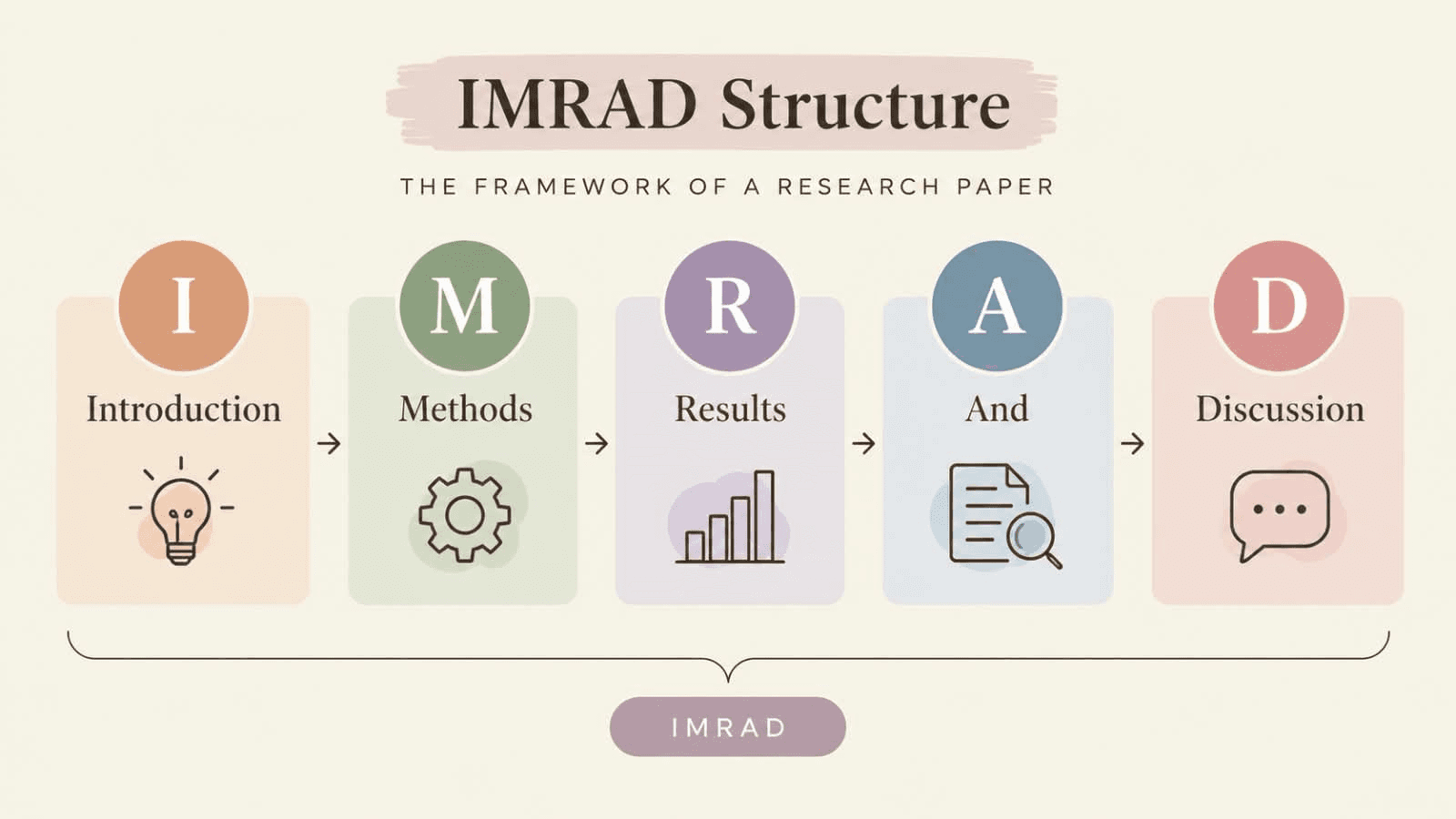
A research paper has three basic parts: Introduction, body, and conclusion, the same logic that applies to every structured writing. If you zoom in, you see that the research paper is described as four main parts, corresponding to the basic IMRAD structure: Introduction, Methods, Results, and Discussion. If you zoom in further, you find a full eight-section structure that this guide covers: Title page, Abstract, Introduction, Literature review, Methodology, Results, Discussion, and Conclusion, and later on, citations and appendices come.
None of these counts is “wrong.” It’s a different level of zoom when seeing a basic framework. When someone asks about three basic parts of a research paper, then it actually asks for the big-picture shape. When someone asks about all eight or ten parts, they actually ask for those specific parts that are expected to be found in a research paper.
Understanding the IMRAD Structure