How to Write a Research Rationale (With Examples)

Key takeaways

  • A rationale in a research paper explains why your study is needed; explain the objectives and what it will do.

  • It has four parts: context, the gap, why the gap matters, and your approach.

  • Name a specific gap, not a broad topic, since vague claims are what reviewers reject.

  • Support every claim with literature rather than personal opinion.

  • Most researchers draft it last, once they can see what the study actually showed.

  • Use present tense for aims, past tense for what previous studies found.

An evaluator reading your paper for the first time. A sudden question comes to mind: why is it necessary to investigate before analyzing any observational evidence? You answer this question at the beginning of your paper; your study’s rationale and the effectiveness of the explanation shape how much critical analysis you do in the rest of the paper.

Many students and undergraduates rush through this section in a hurry; they think that this is a common formality before starting a real manuscript. It is very important to avoid this mistake, because it is the basis and reason for everything. It works as an important connector, which changes this sentence “I choose this common subject” into “this specific research design, executed today, fills an existing gap,” and your whole literature background and methodological framework depend on the strength of that connection.

A rationale is such a writing type whose basis must be on a solid foundation. The article below will help you understand the importance of a rationale; it will be helpful in building a strong rationale with detailed explanation. 

Ready to write with Multilo?

Download the desktop app and open your first project — free to start.

What Is a Research Rationale?

A rationale in research paper addresses three issues in sequence: Your methods are right for addressing it, a knowledge gap exists, and it is significant.

Think of it as the persuasive justification for your project before execution. It’s a justification, not a presentation of results.

A rationale placed near the end of your introduction comes before your main questions or study goals. Although brief—across only a few paragraphs—it holds substantial influence over your audience. Evaluators, academic advisors, and peer reviewers often judge your paper’s overall consistency by the strength of this section.

Importance of a Strong Research Rationale

Below are the essential functions an effectively constructed rationale performs for your manuscript:

  • It validates your chosen topic: explaining why you chose this issue instead of something else to investigate.

  • A strong research rationale showing that you are familiar with the existing body of work and know what has already been proven and what has not demonstrates your knowledge of the field.

  • It provides the reader with some background information about the subject you are proposing to investigate.

  • It focuses you as the researcher by narrowing your topic before you begin experimenting or gathering data.

  • It makes you look good to evaluators: most people who review grant and thesis proposals love seeing stated missions.

Even the strongest research project appears messy and unclear when using poorly worded reasons. In fact, because of a weak rationale, many funding agencies reject grant applications, and thesis advisors often request changes to a rationale section of a thesis proposal. What should a strong rationale include? We will examine those next.

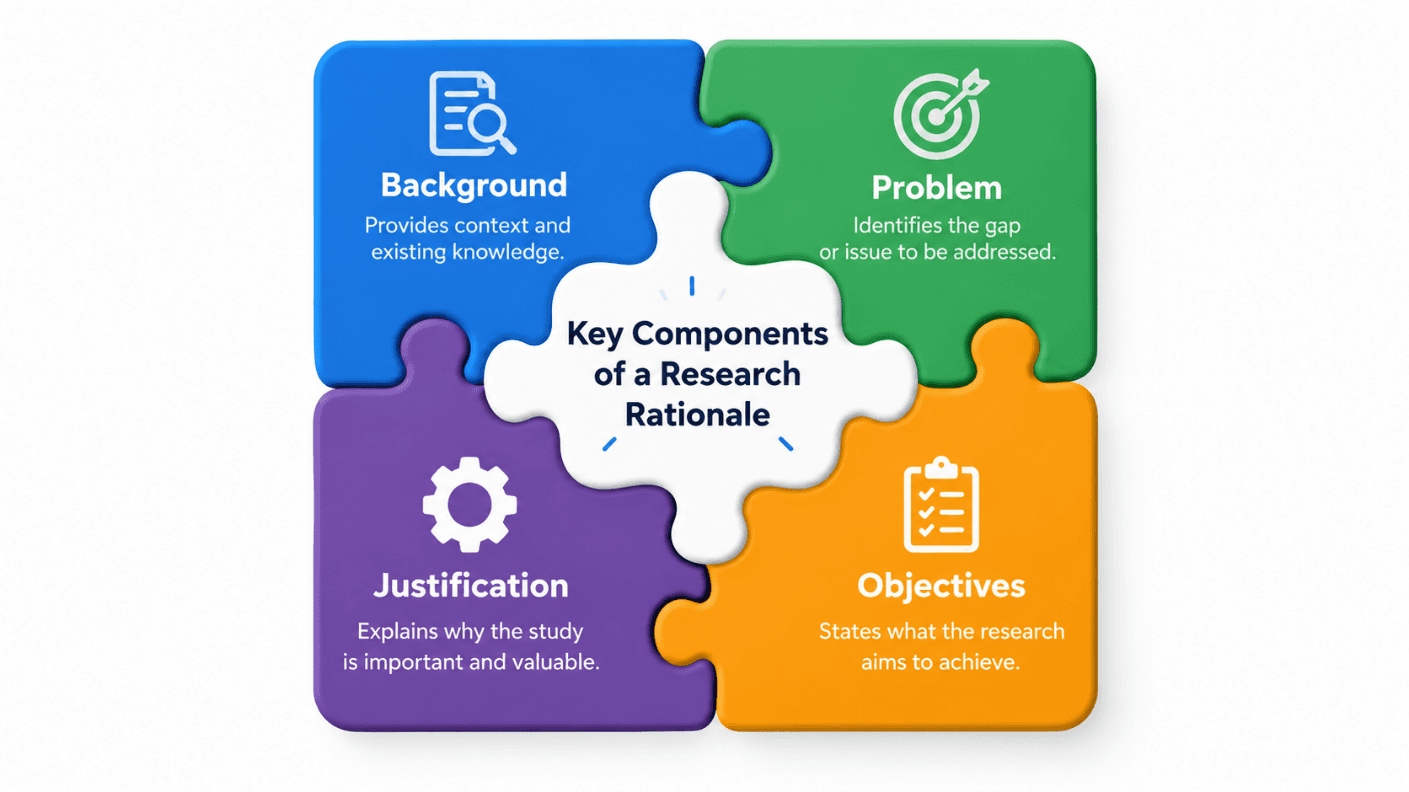
Key Components of a Research Rationale

A research rationale is usually placed at the end of your introduction, and it includes the following components:

Contextual Background

This section includes a brief background of your research topic and also tells how much work has been done in the broad field. The main purpose is to connect the reader with the topic and make them aware of the current scenario.

Problem Statement

It indicates what gaps, unsolved problems, and limitations in previous literature have been left that have not been explored by anyone. It explains that your topic is not repetitive; it genuinely addresses a problem.

Relevance and Significance

In this component, you not only discuss why your research is significant for the recent scientific and academic field but also explain how relevant it is to current research gaps. Its purpose is to prove in what way your research is helpful in solving the current issues.

Research Objectives and Methodology

Conclude your research rationale after a brief analysis of your proposed solution, where a separate chapter with extensive details of the methodology will be left so that the reader believes that your conversation ends on a solid note. At this stage, explain why your methodology is better for your research question, and after completing four components, do an analysis that either, by combining them, makes a strong rationale or not. Besides this, clarify your goals and objectives such that the research direction and smooth transition appear.

How a Strong Rationale Looks Like

When a rationale is specific, evidence-based, and well-structured, it looks efficient, while imprecise terminology is the quickest path to weakening a fundamentally sound research concept.

Effective vs. Ineffective Rationales

By comparing these two, you understand what you aim for:

Ineffective: This topic is important and interesting. Many people read it, and it has many benefits. It fails because it doesn’t tell what is missing, doesn’t provide any reason or proof, and doesn’t give any indication of what actually can be done in reality. 

Effective:Much research has been done on social media, but in academic writing, its particular benefits are not understood effectively. It is important because writing skills affect grades and long-term success.

This study analyzes how different levels of social media use correlate with students’ performance. It works because it identifies a small and specific gap in research, gives a solid logical reason why that gap is a problem, and demonstrates clear, measurable objectives.

Main features of a strong research rationale:

  • Use of concrete assertions based on literature instead of vague generalizations.

  • Explicit connectionOf the issue identified to the general practical or theoretical significance of the study.

  • Use of decisive language, avoiding such phrases as “appears to be” or “possibly.”

  • A smooth progression from contextual backgroundTo the core problem, justification, and research goals.

We should address a common source of confusion that frequently misleads researchers before exploring the writing steps.

Rationale vs. Purpose of the Study:

Researchers often confuse these two terms; therefore, they often intermix them.

The rationale for research explains why the work is needed and identifies the issue that the work tries to address. In contrast, the study’s purpose is its goal, typically stated concisely in one sentence.

A trivial difference between the two concepts is that the former is explained “because,” while the latter is defined as “to do….“ Suppose it centers on “to”; you are crafting the purpose statement. Saying that “this project is necessary because existing findings on telehealth tools are outdated” is an example of a rationale. On the other hand, stating that “this study aims to evaluate the dependability of digital healthcare tools in local clinics” reflects an objective-oriented approach. Although both components are essential and usually proceed sequentially, merging them creates a justification that resembles a list of targets rather than a compelling argument.

Rather than looking at difficult and complex things at once, let’s look at how we formulate your rationale, step by step, in easily solvable parts.

How to Write a Rationale for a Research Paper: Step-By-Step Guide

Step 1: The Research Gap Identification

If you start reading studies on the same topic with one focus, then what aspects have been left out of research? Gaps that are not covered are sometimes distinctive in a few ways: a topic studied in one region but not another, a group of people that has not yet been addressed, or even an opposing conclusion that should be reconciled.

Step 2: State Your Problem

Briefly define the gap in a sentence or two after you identify it. The question may need refinement if researchers are not defining the problem concisely and. Avoid using unnecessary terms, which makes your writing claim weak.

Step 3: Illustrate the Importance

That’s the step where you convince your reader. You can convince him in the following ways:

  • In practice, you identify and solve the problem.

  • In academia, you identify and fill the gap that exists in previous literature.

  • In social, improves the outcomes.

Step 4: Coincide with your study aims

Your aim must be clear and aligned with the overall argument of your study. Explain to your reader how your study resolved their issues. There is no need for a detailed explanation; one or two sentences of a brief introduction of your research goals or research questions are needed.

Step 5: Justify Your Methodology

Shortly describe why your research methodology (qualitative, quantitative, mixed method, or empirical) is better to answer your research question. At this point, you don’t need to explain anything in an extensive way; you have to prove that your research methodology is chosen wisely after critical thinking.

Step 6: Examine your rationale to polish it

Remove any evasive language and check for a consistent verb tense. Make sure each sentence says something. The rationale should give a sense of purpose from start to finish, rather than being an intro to the rest of the paper.

Coming up with ideas is nice, but seeing them come true in other places is much more enlightening. Here is such an example.

Example-Led Breakdown: Different Types of Rationale

Research rationales may differ depending on the field of study and document types. The following research rationale examples show how this paragraph changes in three different research projects.

Journal Article in Healthcare

Health-related arguments usually relate to therapeutic utility and effectiveness for the patient. For example, if one reads an article about a new way of testing a patient for early diagnosis of diabetes, one can argue that this method is needed because current screening procedures do not consider such a test. By addressing this issue, diabetic patients will not have long-term negative health consequences and incur high expenses. In this case, the argument appeals to practical consequences, both in terms of health and finances.

Master’s Thesis in Education

A thesis rationale typically relies heavily on Conceptual models and published literature. For example, a study measuring the effect of experimental learning in a rural school setting may base its justification on that most of the prior research in this area was focused on urban or privileged schools, meaning that there is a lack of information on the use of this particular strategy in areas with limited resources and a larger teacher-to-student ratio. The justification would then focus on the project’s importance in light of current debates about equitable access to modern educational opportunities.

Research Grant Application in Engineering

Technical and engineering rationales focus on the practical side of things. A grant to introduce a novel water purification system could justify its costs by showing that no effective filtration systems  work with limited resources available. It would then appeal to the funder’s interests by stating why it is important—affordable, safe, and easier to scale.

The same pattern is evident throughout all three prompts with minimal variations—context, problem, value, and solution. Only the language and the rationale change depending on a field of work.

A few typical questions often come up at this point, so I will briefly answer them to move on to the next section and potential pitfalls in writing.

When Is the Research Rationale Written?

You can write your research rationale before or after conducting your study. Most scholars write it at the end of the study. At first, when you select your research topic, you apply for funding to implement it. Then, when you have completed your study and are writing your paper for publication, you explain in this why you are writing on this topic and how it worked out.

Although research rationale is part of your introduction, it is good to write the rationale at the end of your study. Because then you can easily convince your reader why your study is important.

What Is the Ideal Length for a Research Rationale?

If you are wondering, “How long a research rationale should be” then the length of the rationale is ideally not fixed. It depends on the guidelines of the journal or sponsor for whom you are writing. Like some ask for a fewParagraphsFor a research rationale. The introduction in your research rationale must be 200 words,Including two to three sentences of the background of your rationale.

The research question usually demands a detailed justification, and the research rationale in a thesis will be longer than a journal article.

Which Verb Tenses to Use in the Research Rationale?

Multiple tenses are used in the research rationale. It depends on what you are talking about in your sentence:

  • Most commonly used simple present tense:When you discuss objectives, importance, or current general facts in your study, then present tense is used (“This study Aims To investigate…”.

  • Simple past tense: When you cite previous literature or tell what they said or discovered in your rationale, then past tense is used (“Previous studies ReportedSignificant limitations in drug release…”).

  • Past perfect tense: When you want to describe what work has been done from the past up to the present (“Several researchers Have exploredVarious formulation strategies…”).

Correct use of tenses in rational makes your text look logical. Use of tenses as depicted above, where it is suitable, connects previous findings with your novel study’s contribution.

If your rationale is poorly structured, then there are high chances of errors; therefore, we should focus on some common mistakes to avoid.

How to Avoid Common Mistakes
The following errors are common in your research rationale, but your main focus must be to avoid such mistakes:

1. Failure to address the research gap:Your focus must not be writing your research rationale and filling it with wording; you must identify the research gap and address it in your research rationale.

2. Making the research too broad:  Avoid trying to cover an extensive topic in your research, make it to the point, targeted and specific to the targeted point.

3. Relying on your personal opinions:  Don’t try to put your personalOpinions of what you feel in your writing; validate your research rationale with authentic evidence.

4. Failure to focus on the study’s significance: Mention the purpose of your research. Must explain who will benefit from your research and how much it is helpful in the corresponding field.

5. Distracting from your aims: Justify your writing with your research question and objectives. Do not write a study that fails to address your main objective of the research.

When you’re done reviewing your common mistakes, then it’s time to evaluate your research rationale against the following checklist.

Rapid Evaluation Checklist for Rationale

Use this checklist to make sure you’re that you haven’t missed anything before finalizing your research rationale:

  • Contextual background is concise and focused to avoid an extensive literature summary.

  • The Problem Is formulated specifically and is explained using simple terms.

  • Academic or practical importance is explicitly articulatedRather than left implicit.

  • The main goalsOr questions are introduced briefly, even if only mentioned.

  • Methodology is provided even if it is briefly described.

  • The same tenseIs used throughout the whole paper, and each sentence has a specific purpose.

  • The passage transitions smoothlyFrom background context to justification and a final preview.

Checklists are great, but writing a paper under time pressure is not the best idea. Here is how it should be done.

Tools and Habits That Make Writing a Rationale Easier

Using certain habits and tools can help you write a rationale faster while still maintaining a high-quality argument:

  • As you do your literature review and background research,Keep a running “limitations tracker” of every confounding variable, population that wasn’t studied, or conclusion that was found to be outdated. As you prepare your rationale, you will discover that you already have several problems to address on your own and not an empty page in front of you.

  • Use reference manager tools such as Zotero or MendeleyTo keep your citations organized and easily accessible as you prepare your rationale or argument.

  • Review published rationalesFor your target journal, magazine, or newspaper beforehand. Every field has slightly different conventions for what makes a rationale intriguing.

  • Ask your fellows To read your rationale; if they do not understand your research objectives, it means you have to work on it.

Frequently asked questions

How can I create a rationale if my research topic has been extensively studied?

Address a less common aspect of your field of study, for example, a particular group of people, a specific location, a unique approach, or a specialized time period that has been under-researched instead of a generalized one.

What is the difference between a rationale and objectives in research?

Rationale provides an explanation of why a study is necessary, while objectives define specific goals that a researcher will achieve. In other words, the rationale provides a logical basis for research objectives.

Should a research rationale include references?

Yes, including references shows that you have done background reading and research on the topic and helps support your argument for the need for your research.

Is a research rationale identical to the significance of the study?

No, but they are closely related. The rationale is the complete justification of your work, including the background information, the problem statement, and the values, while the “significance of the study” usually refers to its independent benefits. Therefore, a well-written rationale can do much more than provide a background for your paper. It builds trust with your audience before revealing your findings. So, be as thorough and invested in this section as you are in your findings chapter.

Share this post

Related posts

Browse all posts