Literature Review Matrix Template That actually works

In short

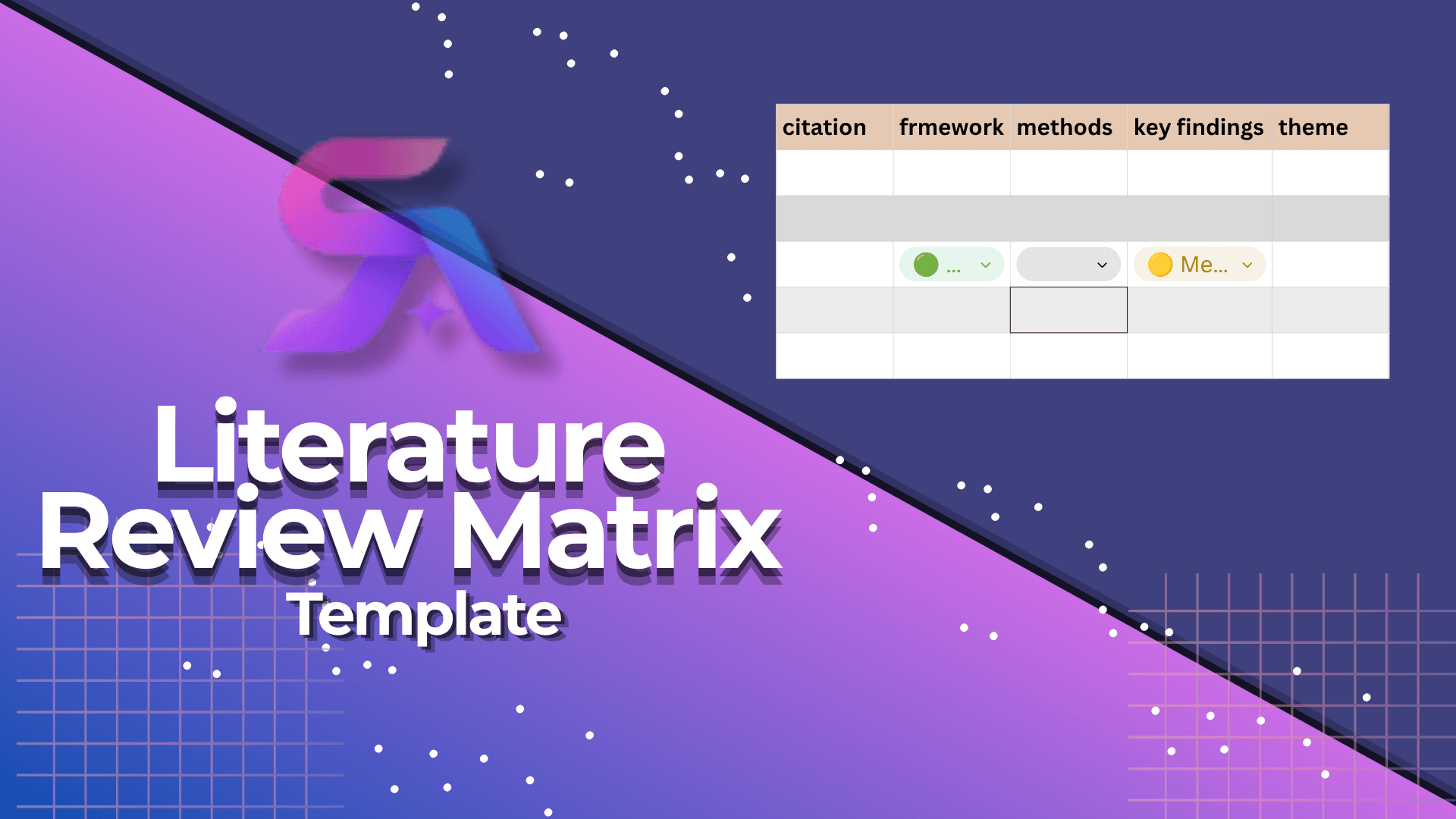
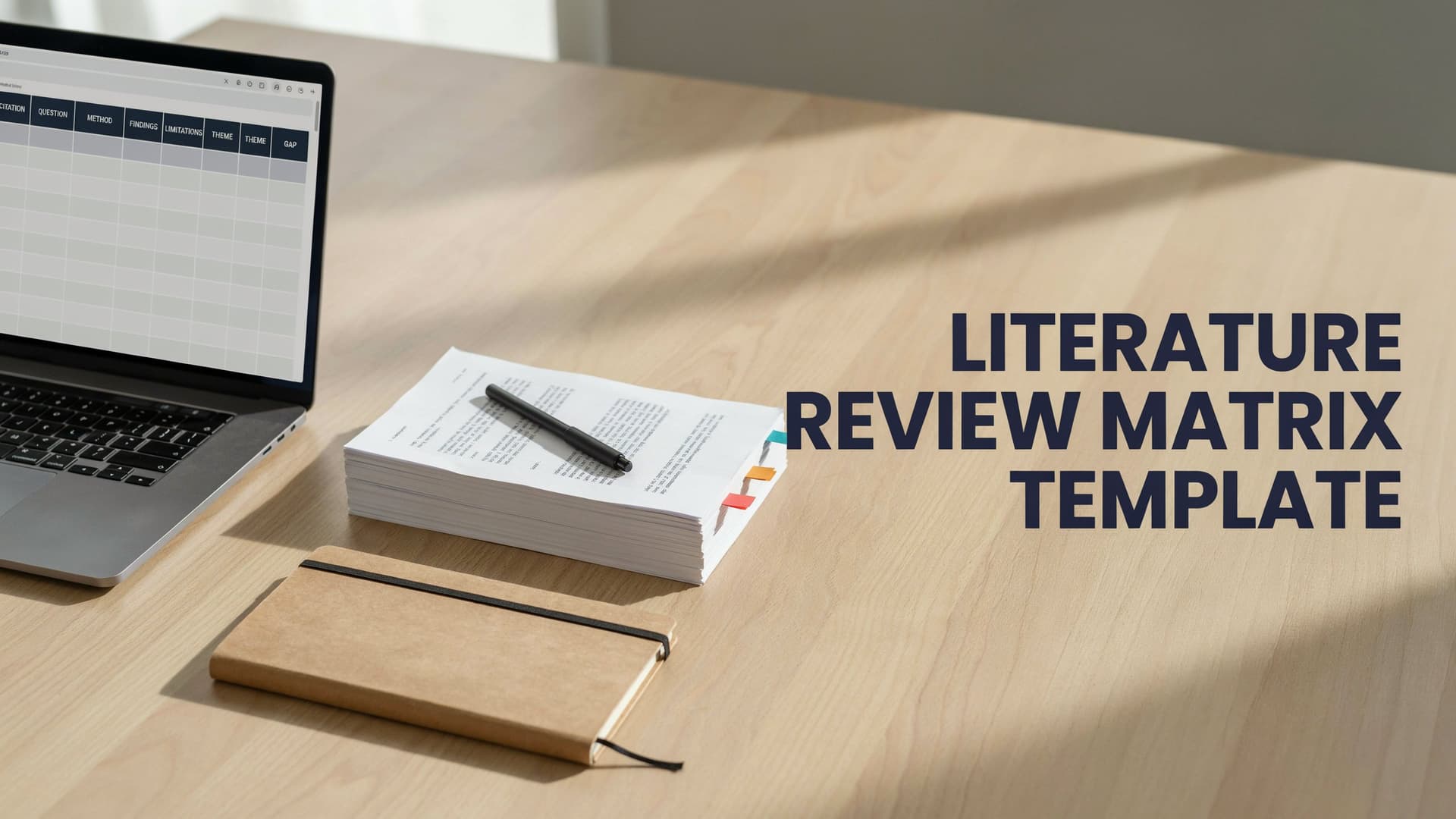
A literature review matrix is a table with one row per source and columns for the details you’ll need while drafting. This guide covers the template, what belongs in each column, how to build it as you read, and how reading down a column turns the table into written sections.

Key takeaways

  • A matrix is a table with one row per source and one column per detail you’ll need later.

  • Fill in each row right after reading, not weeks later from memory.

  • Write findings in your own words, so your draft starts in your voice.

  • Add theme tags after ten to fifteen sources, once real patterns appear.

  • Read down a column, not across a row; that’s where the analysis happens.

  • Repeated absences in the gap column are a research gap you can prove.

While you are writing or researching a specific topic, you are focusing on every detail that the paper covers. And when you write it that way, this is the most common comment students hear from supervisors: “This reads like a list of summaries rather than a review.“It doesn’t mean you read the wrong papers, but it is that the comparison happened in your mind instead of in a review. 

Therefore, aLiterature review matrixIs where that comparison becomes visible, and you can deliver your research points more. It is a table where you record each study’s main points like methods, aims, materials, key findings, limitations, etc. in an organized way. 

Thus, once all your studies sit side by side in the same columns with every detail, you can easily compare their results: which findings repeat, which contradict, and what is the question that nobody asked yet. By the end of this guide you’ll have a working template, a good understanding of what goes into each column, and a repeatable way to turn the finished table into your first draft.


Ready to write with Multilo?

Download the desktop app and open your first project — free to start.

What a Literature Review Matrix Does

A literature review matrix is a table, usually made in Excel or Google Sheets, where you record important details about each source. Each row represents one source, while the columns can include information such as the research question, method, main findings, and other details you need. Instead of trying to remember information from twenty different articles while writing, you can keep it all in one place and refer back to it when needed. This literature matrix makes it easier to compare sources as your review grows.

You may start to notice patterns that are difficult to see when you are relying on memory alone. For example, three studies might use the same method, two studies might disagree on the same question, or a particular area may not have been studied yet. These patterns can help you identify the main themes for your review and clarify how to organize your outline. A synthesis matrix for a literature review can bring these together and make comparison across sources much easier.

Literature Review Matrix Template

Here is a blank matrix you can copy into Excel or Google Sheets and start analyzing your work-related sources in an organized way.

Sheets template]

Author & Year

Title

Framework

Research Question

Design & Sample

Findings

Limitations

Gap

Theme

Why I’m Keeping It


What Each Column Means

Column

What to record

Tip

Author & year

The author’s surname and the publication year

Makes it easy to match rows to your reference list later

Title

The full title of the source

Add the journal name if you are citing many journals

Framework

The theory or model the study uses

Write “not specified” if there isn’t one, so you know it wasn’t skipped

Research question

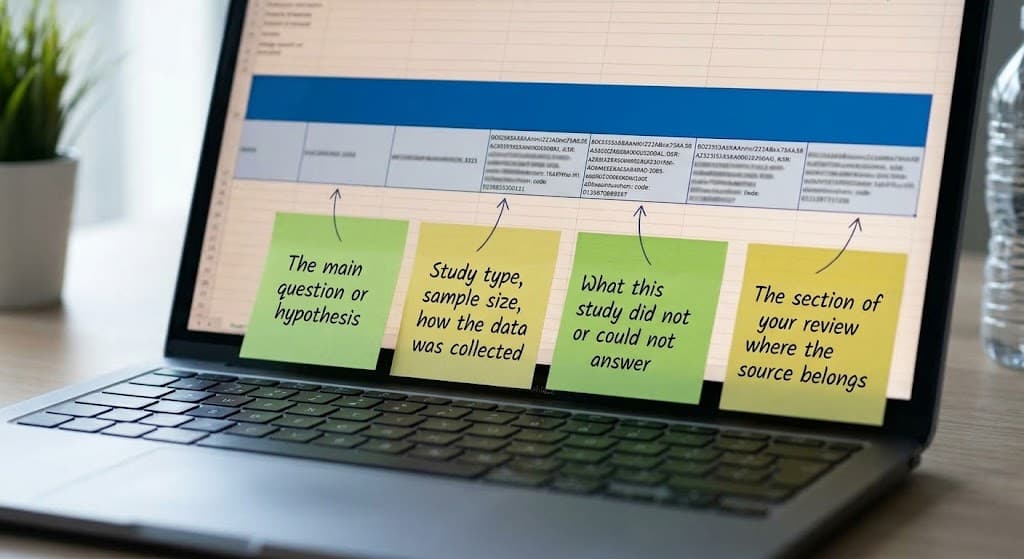
The main question or hypothesis

Keep it to one line

Design & sample

Study type, sample size, and how the data was collected

“Survey, 340 remote workers” is enough

Findings

The main results, in your own words

Paraphrasing now protects you from accidental plagiarism later

Limitations

Weaknesses the authors admit, plus any you notice

This column explains why studies disagree

Gap

What this study did not or could not answer

Repeated gaps across rows become the case for your own research

Theme

The section of your review where the source belongs

Leave it blank until you have read ten to fifteen sources

Why I’m keeping it

The reason this source is in your review

If you cannot answer this, you may not need the paper

The theme column is the one that turns your matrix from a storage space into a writing tool. Once every source has a theme, you can filter the spreadsheet and see everything you need for one section of your review.

Moreover, you can also add other columns such as key variables, measurement tools, and quality ratings if your field of study demands such specifications. Most students design the template according to their field; for example, health science reviews often include an evidence strength column. Many writers add a “my notes” or “why I am keeping it” column for their own understanding to each study, which gives you a head start on analysis.

It is best to keep every cell to one or two sentences. If you are writing a paragraph in a single cell, you are transcribing rather than distilling. The point of the matrix is that you can scan it.

Adapting the Matrix to Your Review Type

The basic columns can work for most reviews, but you may need to adjust them depending on the type of review you are writing.

  • Coursework review:Leave out the gap column and add a “why I’m keeping it” column instead. Since the focus is usually a clear discussion, around 10–20 sources may be enough.

  • Thesis or dissertation chapter:Add columns for the theory or framework and the research setting. It is also useful to keep a separate sheet for the sources you screened out and the reasons for leaving them out.

  • Systematic or scoping review:Add a quality rating and screening decision for each study. You can use tools such as Casp, Mmat, or a suitable risk-of-bias tool. Prisma is used to report the review process, not to score individual studies.

  • Humanities review:Instead of design and sample, focus on the critical approach used by each author. You may also want to group sources by school of thought or time period rather than research method,

Source Matrix vs. Synthesis Matrix

These two terms, “literature review matrix” and “synthesis matrix”, are mostly considered the same, but some guides explain a clear distinction between their layouts.

A Source matrixIs organized by sources, where each row describes a different source, and columns are arranged for details. For this, the same template that is mentioned above is used.

A Synthesis matrixIs based on themes. Each source is written in rows and your themes in columns; each column will explain what the source says about that specific theme. For example,  

Source

Theme 1: Productivity outcomes

Theme 2: Influencing factors

Theme 3: Research limitations

Study A (2021)

            —

Dedicated workspace matters

Relies on self-report

Study B (2023)

Early dip, then gains

            —

Shows short studies miss long-term effects

Most researchers or writers start their work with a source matrix and establish their themes, and then switch to a synthesis matrix once each theme is clear. It helps them to understand source studies more. They will know where the sources agree, disagree, or which cell (theme) is empty; that can help identify areas for further research.

How to Build Your Matrix

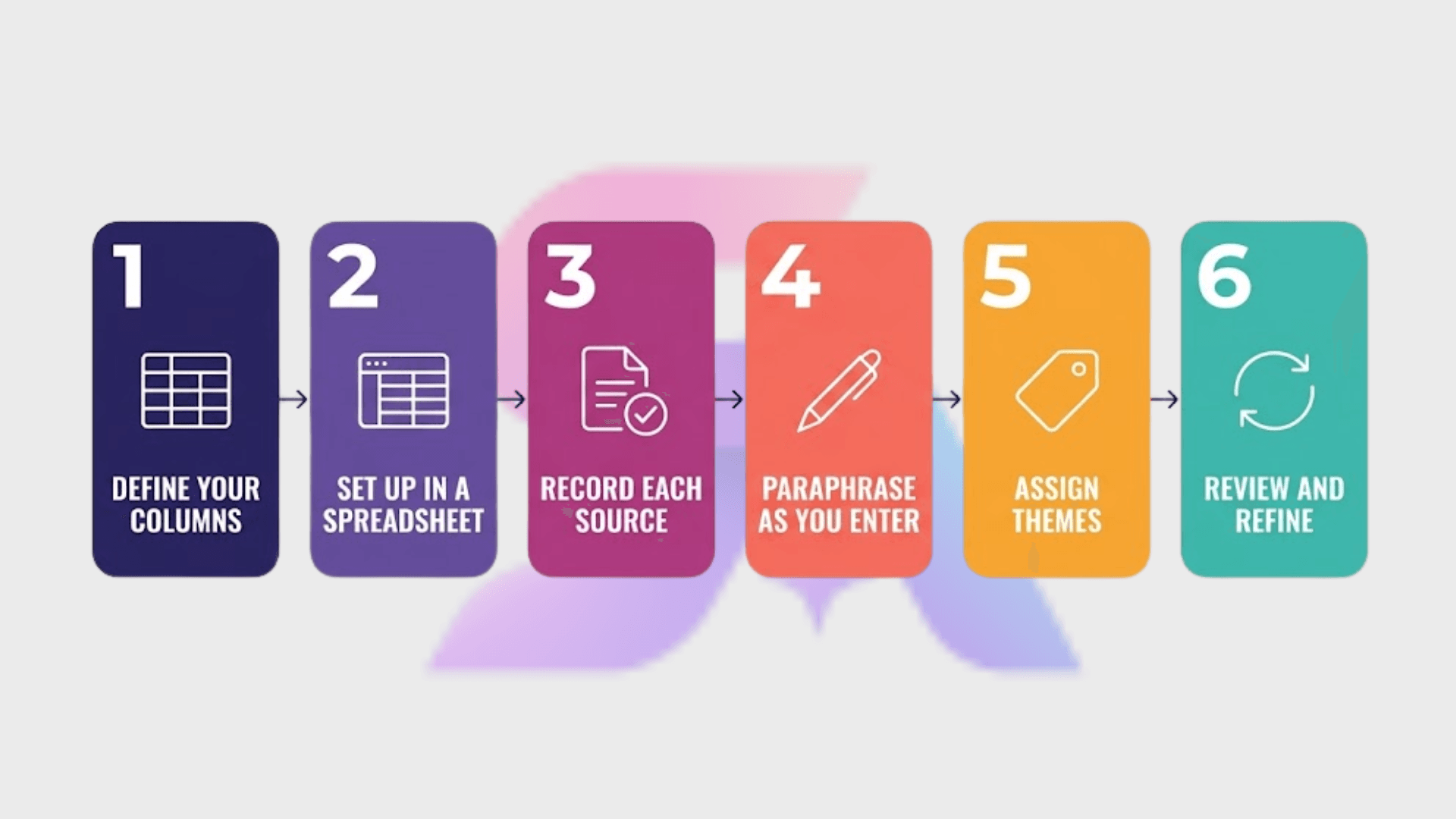
Building a literature review matrix is easier when you follow a simple process. You do not need to make it complicated.

Choose your columns before you start reading. 

Start by choosing the columns you want. You can use the standard columns from a literature review matrix template or change them to match your subject and research needs.

Choose a tool for your matrix (spreadsheet or Word document)

It is better to use a spreadsheet, as it lets you sort and filter your sources, which becomes very helpful when your literature matrix starts getting larger. You can also use an Excel literature review template if you want a ready-made structure. Plus, a table in Word or Google Docs also works well but for a shorter ten-source class paper because you cannot filter it and it becomes unwieldy quickly.

If you already keep your PDFs in Zotero or Mendeley, let the reference manager own the citations and export them into your citation column. That keeps your reference list and your matrix consistent.

Fill in each row right after you finish a source. 

Do not wait until you have read all your sources before filling in the matrix. If you wait too long, you may forget important details and have to go back and read the same sources again.

Write findings and conclusions in your own words. 

Write the findings and conclusions in your own words instead of copying sentences from the source. This helps reduce the risk of accidental plagiarism, especially if you later use the same wording in your paper without quotation marks. More importantly, it helps you understand the sources more. 

For example

  • Copied “Results suggest that participation in the mentoring program may be associated with improved retention outcomes, although effects varied considerably across sites.”

  • Paraphrased: “Mentoring linked to better retention, but results differed a lot by site.”

The second version is shorter, scannable, and already close to a sentence you could use in your review.

Group your sources into themes 

After you have added around ten to fifteen sources, you can add the theme column and start grouping your sources. Go back to your earlier entries and give them appropriate theme tags. This step will clarify many things for you, for example

  • Which studies make similar arguments or report similar results

  • Where papers directly contradict each other

  • Which topics have plenty of research and which have only one or two papers

The themes may differ according to your field of study. For example, for a review of AI writing tools, the themes may include the studies with better writing quality, studies that argue that results depend on what the tool is and how it is introduced, or the studies with no measurable effect. Once you have established these clusters, it will help you organize your literature review outline. 

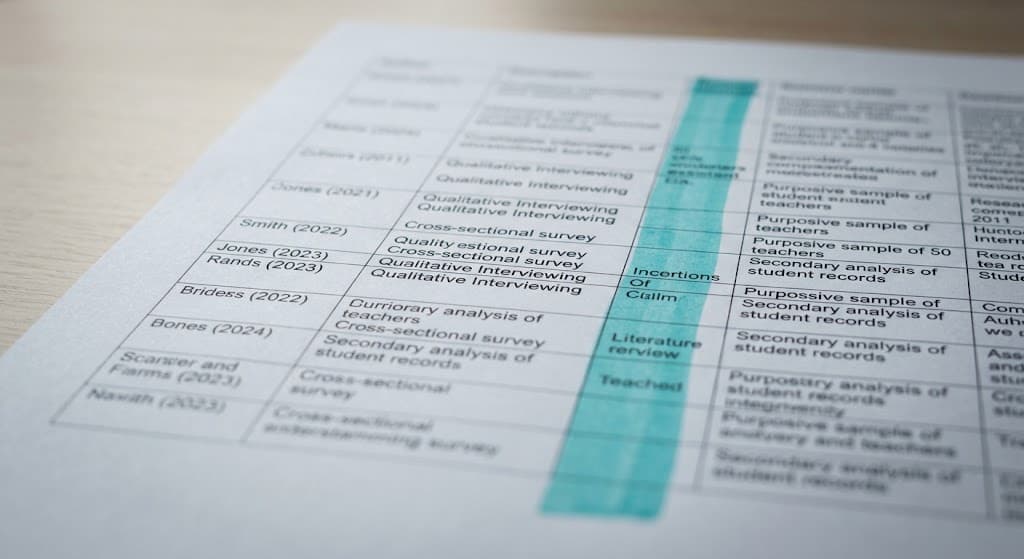
Try color coding. You can assign each theme a highlight color. In this way, you can see in which argument or theme the most work is done and where the single contradicting study sits.

Keep updating. 

Do not worry if your themes change later. As you read more research, you may notice new patterns or decide that some sources fit better under a different theme. It is much easier to update a lit review matrix than to rewrite an entire section.
Reading Down the Columns

After you are done with your literature review matrix, the next step is to analyze it and give it a proper shape to put in your actual review. Most researchers spend a lot of time analyzing the matrix by reading across rows, which is another way to review one study at a time, not a comparison.

The analysis happens when you read down the column, as each one answers a different question about the field as a whole. For example, in the following table, there is a general case explained around each column.

Read down this column

And you observe

Which gives you specific understanding like

Design & sample

You observe how the field studies the question

Your analysis:“Most evidence comes from single-district studies with fewer than 200 participants.”

Findings

Where results agree and where they disagree in specific findings

“Sleep gains are consistent across studies; academic effects are not.”

Limitations

Why studies disagree (reasons)

You observe that “the two studies reporting no effect both measured outcomes within one term.”

Research question

What the field keeps asking, and what it skips

“No study asked how families responded to the change.”

Gap

The opening for your own work

“Long-term outcomes remain unmeasured.”

These observations help you draft the finished literature review.

Locating the Gap

A gap is not a study nobody has published. Stated that way, it is unprovable, and reviewers treat it as a guess. A gap is a pattern of absence you can point to in your own table.

Reading down the gap column usually surfaces three kinds:

  • Population gaps:Every study samples the same group. If nine studies use urban schools, rural experience is unexamined, and you can name the nine.

  • Method gaps:Every study uses the same approach. Consistent self-report data means objective measurement is missing, whatever the topic.

  • Time and context gaps:Every study stops at the same point. Five studies ending at eight weeks say nothing about the following year.

The difference matters in your writing. “No research exists on this” invites a reviewer to find a counterexample. “Across the twelve studies reviewed here, none followed participants beyond a single term” is a claim your matrix supports.

A Filled-In Example

Below is the example filled in to show exactly how you can fill the Excel template for a literature review

Citation

Aim

Method

Key Findings

Limitations

Theme

Study A (2022)

Measure AI feedback’s effect on writing quality

Quantitative, 120 students, 8 weeks

Grammar and clarity scores improved in the AI group

Short study period

Improves writing quality

Study B (2023)

Understand how students perceive AI tools

Qualitative interviews, 20 students

Students reported more confidence editing their own work

Self-reported, no performance measure

Improves confidence

From Matrix to Your First Draft

These steps help you organize your literature review draft with proper alignment and smooth transitions so that it doesn’t seem like a summary but a well-researched review of previous studies.

  • First,Filter the common studies to one theme And write that section only according to those rows.

  • Open your paragraph with What the studies share And then Explain the disagreements. The limitations and design columns help you organize those thoughts.

  • Use the design column to Characterize the field once per section,Explaining how different studies address the question.

  • Close each section withWhat the source left unansweredThat you can easily analyze from your gap column.

  • Plus, write theIntroduction and conclusion section at lastWhen you can see the patterns.

Use this type of analysis for each theme and organize them. Your theme tags eventually become the section headings; that is why the literature matrix is already playing a critical role in creating a literature review outline.

Three Tests Before You Start Writing

You should analyze the following patterns before starting to write,

  • The heading test:Look at your theme tags. Could you use them as section headings and make a clear point with each one? If they only name a topic, make them a little more specific.

  • The conflict test:Take two studies that disagree. Can you explain why their results are different by looking at their methods and limitations? If not, you may need to add more detail to your matrix.

  • The gap test:Can you point to the specific studies that show your research gap? If you cannot, and the gap is based only on something you have not seen in the literature, keep digging

If all three work, you probably have a good idea of how your review will come together. If one does not, it is easier to fix the matrix now than rewrite the whole chapter later.

Mistakes That Quietly Break a Matrix

These are the common mistakes that students make while working on a literature matrix.

  • Students sometimes Stop filling the columnsThat they find difficult, thinking, “I can fill it later.” An empty column doesn’t specify whether the study lacked this point or you didn’t write it. So instead of leaving it empty, either write 'unspecified' or fill the column before moving to the next study.

  • Not naming the theme tags properlyWith identifiable headings. For example, if you say 'engagement' in one of the themes, it cannot become a heading or give you an understanding of what these studies actually were. This type of table never turns into a draft.

  • Pasting abstract sentencesWithout actually understanding or paraphrasing them can lead to extreme pressure while organizing them before the deadline.

  • Also, students don’t give much importance to the papers that were irrelevant and Do not record what they excluded. It causes them to read those papers twice, wasting time and effort.

  • Researchers should compare the studies down the column, as we mentioned before, as Reading across rowsDoesn’t identify differences.

Share this post

Related posts

Browse all posts