Why Researchers Build a Dossier Before They Write a Single Word
The dossier is easy to skip under deadline pressure, but it consistently pays off in a few recurring situations:
Grant applications—give you a single, ready reference for the "background and significance" section, instead of re-researching under time pressure.
Advisor or committee review—communicates the state of your reading far faster than pointing someone to your citation manager.
Systematic reviews—doubles as the documented, auditable trail these reviews require.
Team research—prevents duplicated reading when more than one person is covering the same topic.
Paused projects—let you resume months later without rereading everything from scratch.
Building a Research Dossier by Hand: A Six-Step Process
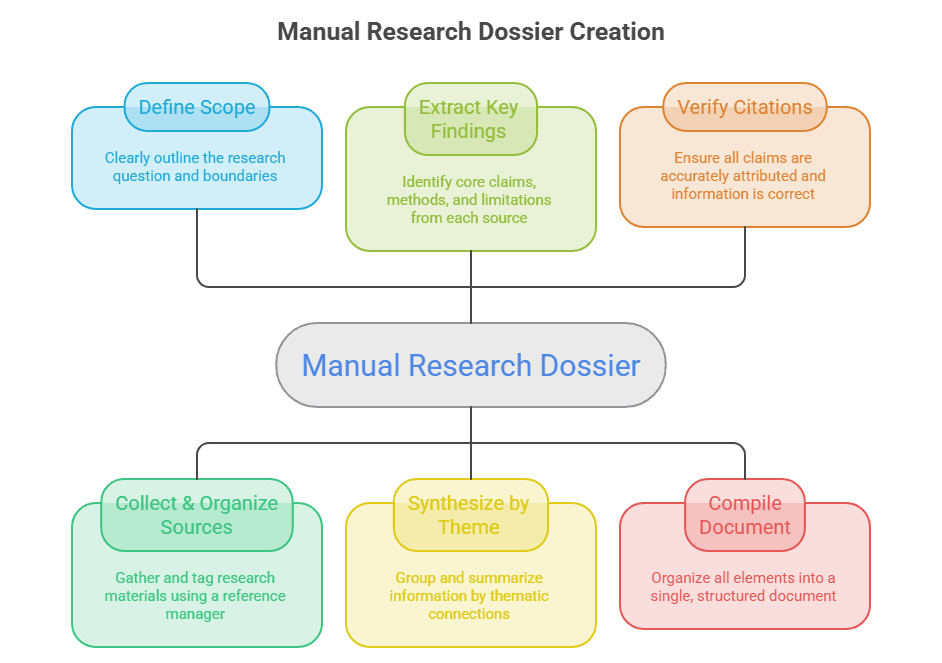
There are basically two ways to build a research dossier, i.e., manually or through AI tools. Manually, it takes a lot of time and effort to build one, but that way you can ensure the credibility of the document. The following are the six steps to follow based on the core elements of research dossier generation.
Step 1: Define the scope before you start reading
Write down the specific question or boundary within which the dossier will be developed. In this way, you’ll know clearly what you should work on and how much depth you should go to fulfill the task. This single step can make the dossier easily manageable.
Step 2: Collect and organize sources as you find them
Then, start researching the topic and use a reference manager—Zotero, Mendeley, or others—from the start. You should tag sources by theme and relevance from the beginning to avoid confusion and extra work at the end.
For each source or paper you find, determine its core claim, the method they use, or any limitations or future research statements that they flagged themselves. These unresolved claims can help you find what is really missing in the field and what you can work on clearly.
Step 4: Synthesize by theme, not by source
This is the step that most people skip, and that is what makes the dossier valuable. You should separate or align the sources by theme and add a short synthesis paragraph of that specific theme or sub-question describing what these sources collectively tell, where they disagree, or how strong the evidence is overall.
Step 5: Verify every citation before finalizing
Check every claim in your synthesis that it is correctly attributed to the source and that the information you wrote is accurate. It is best when you are working on a dossier for a long time and don't remember what you read weeks earlier. False or misattributed claims affect the dossier’s credibility.
Step 6: Compile into a single, organized document
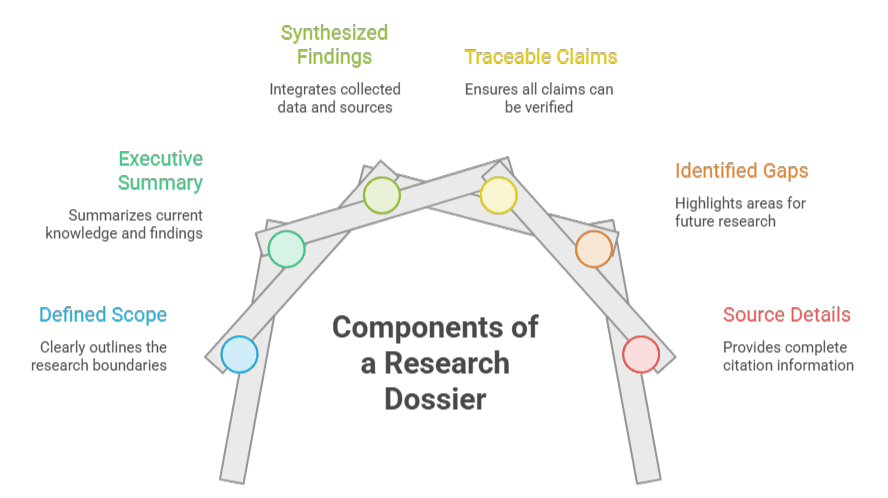
Now write all your collected information, scope statement, executive summary, source analysis, gaps, and full citation list in a single document in an organized way with a clear structure, headers, and highlighted text so that you can easily scan it in the future.
This process is really time-consuming; that’s why research AI tools have emerged in this field, providing a fast, reliable process.