First Mention vs. Last Mention
When introducing a source initially, state the author’s full name and key credentials to establish authority. For all subsequent references, standard practice is to use their surname only. Highlighting qualifications upfront adds persuasive weight to your signal phrases and strengthens your argument’s credibility.
Punctuating Signal Phrases Correctly
This is a common mistake where even highly skilled authors frequently stumble.
Insert a comma prior to a direct quotation when it succeeds an introductory tag: Martinez clarifies, “The statistics reveal a different reality than mainstream media indicates.”
Begin the quotation with a capital letter only if it stands alone as a full sentence. If it is a partial phrase integrating into your own wording, use a lowercase letter—Martinez characterizes the development as “highly misinterpreted.”
Avoid unnecessary punctuation. If the quotation is grammatically integrated into your statement rather than serving as an independent clause, you typically do not require a comma: Martinez argues that statistics “paint a contrasting picture."
And always avoid letting a quotation stand entirely on its own as an independent sentence without any preface. Each cited passage requires some form of transition, however brief.
Signal Phrases Across Major Citation Styles
The fundamental concept of an attribution phrase remains uniform across formatting guidelines, but the specific mechanics vary—mostly concerning preferred verb tenses and whether the publication year or page reference is integrated into the text. Let’s examine how these introductory markers actually function in APA, MLA, and Chicago formats.
APA Style Signal Phrases
APA style operates as an author-and-year system, and its introductory tags typically favor past-tense or present-perfect action words—reflecting the logic that the research was carried out and documented at a concrete point in history. The publication date is placed in parentheses immediately following the researcher’s name, embedded directly within the attribution tag.
Smith (2023) argued that occupational adaptability improves staff loyalty.
Martinez (2022) has discovered that off-site workers experience greater career fulfillment.
According to Chen (2021), salary continues to be a more powerful indicator of tenure and schedule adaptability.
Nguyen and Patel (2020) documented a 13% rise in output for distributed groups.
“As pointed out by Okafor (2024), split–schedule guidelines have failed to match workforce desires” (p. 112).
Whenever there is a quote in APA style, the specific page reference is placed in parentheses immediately following the text, whereas the publication year remains linked to the researcher’s name within the introductory phrase.
MLA Style Signal Phrases
MLA utilizes an author-page structure, and it generally favors present-tense verbs. The rationale is that a written document is continuously making its case, no matter its release date—the content is treated as an active voice rather than a historical artifact. Only the page reference is included in the parenthetical citation, not the publication year.
Jones writes that structure adaptability reshapes the contemporary staff-management dynamics (45).
Martinez asserts that telecommunicating has radically transformed the way organizational performance is evaluated (12).
Chen clarifies that financial reward still takes precedence over schedule freedom as a primary tool for keeping staff (78).
Nguyen and Patel observe that split–week arrangements yield quantifiable increases in team performance (203).
Okafor declares that the majority of business guidelines remain far behind the genuine desires of the workforce (56).
When you have already specified the writer’s identity within your introductory tag, MLA guidelines do not require you to restate it in the brackets—the numerical page location by itself is completely sufficient.
Chicago Style Signal Phrases
Chicago style divides into two distinct formats, meaning your introductory tags will vary slightly based on which framework you adopt.
The notes-and-bibliography method maintains a clean body text, channeling all of the referencing particulars directly into a footnote:
Smith maintains that scheduling adaptability improves staff.1
Martinez highlights that off-site workers regularly document greater job fulfillment.2
Chen asserts that financial reward, not scheduling freedom, remains the decisive element.3
The Chicago Author-date format functions similarly to APA, integrating the year directly into the citation:
Smith (2023) asserts that adaptive work practices improve employee retention.
Martinez (2022) has demonstrated that telecommuting personnel report greater career contentment.
As noted by Chen (2021), financial rewards hold more weight than schedule freedom as a retention driver.
Because Chicago accommodates both styles, it is highly recommended to verify with your professor or target publisher before choosing a format.
Quick Comparison
Style | Tense | Citation Detail in Sentence |
APA | Past/present perfect | Author + year |
MLA | Present | Author only (page number in parentheses) |
Chicago (Notes) | Author’s choice | Author only (details in footnote) |
Chicago (Author-Date) | Author’s choice | Author + year |
Mastering the correct verb tense and formatting style for your academic field may seem trivial, but it is frequently the distinguishing feature between an elegant manuscript and an unrefined draft.
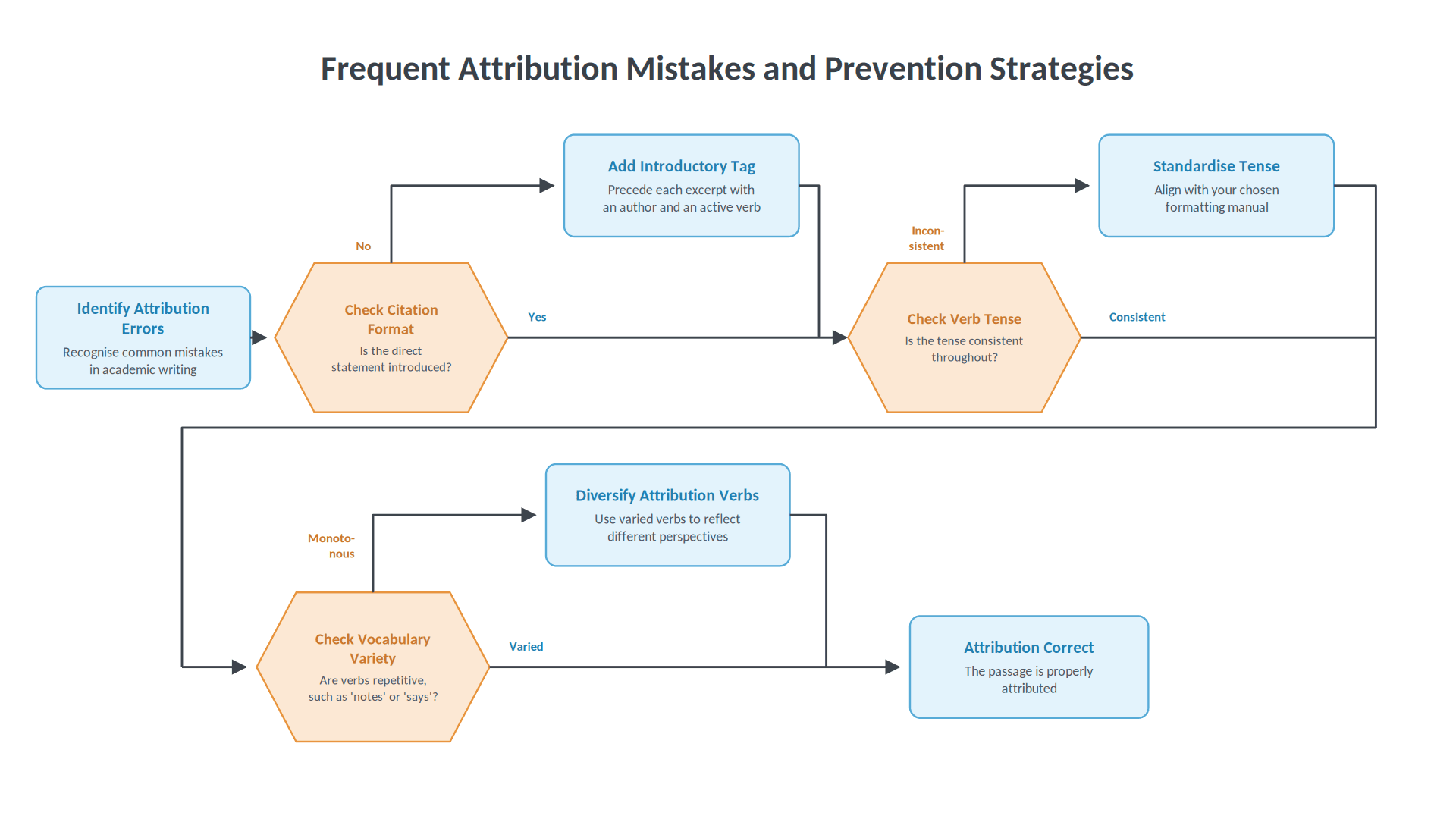
Frequent mistakes with attribution phrases and strategies for prevention.
Several specific errors occur repeatedly, even in the work of accomplished authors.
Unsupported citations occur when a direct statement is placed in a passage without any prior introduction. There is no attributed author, no active verb, and no contextual framing. The solution is highly uncomplicated: each cited excerpt must be preceded by an introductory tag, regardless of how brief it might be.
Verb tense mismatch represents another frequent error. Alternating between present and past actions within a single essay—or even the same paragraph—strikes readers as highly erratic. Identify the specific grammatical tense required by your chosen formatting manual and maintain it consistently.
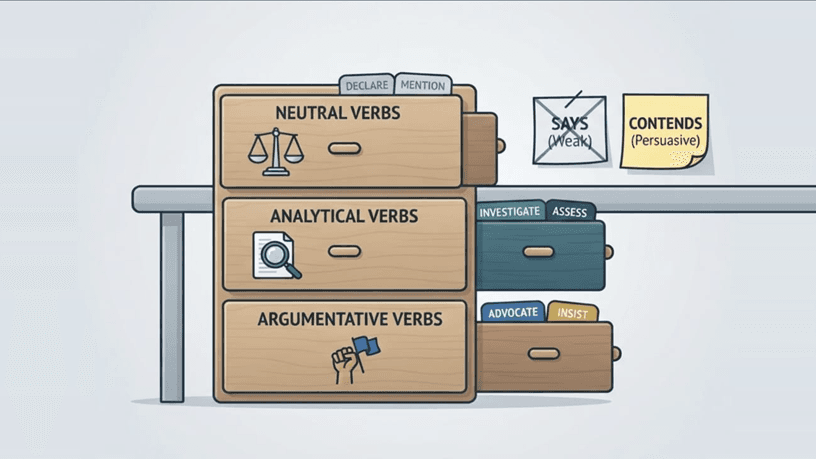
Additionally, writers frequently struggle with monotony: relying on “notes” or “says” for every single quote. While not grammatically incorrect, this habit drains the vitality from your text and homogenizes your references, despite the fact that they are likely presenting vastly different perspectives.