How to Cite the Bible (APA, MLA, and Chicago)

In students' papers, the quiet confusion that occurs when citing the Bible might occur with any other sources. It has no single author; it is available in hundreds of translations, and its “page numbers" are actually books, verses, and chapters. Furthermore, citations have three main styles, and each one has separate rules, because cautious and careful writers are forced to make assumptions.

This guide eliminates this confusion and guesswork. Here, you get a checklist of basic rules for citing the Bible in APA, MLA, and Chicago styles; in-text examples; and templates of references for analysis before submitting it. If you want to know only about MLA style, then go to that part directly. The remaining information is for that day when your professor asks for a different style.

how-to-cite-bible-citations-style

Why Precision Matters in Citing Religious Books

A citation is just like a promise that the reader can directly find that thing that you found. When citing the Bible, in order to fulfill this promise, it is necessary to take care of small details. The same verse, “King James Version,” might be different in any other translation. Therefore, if you do not write the version name, the reader cannot check your written words. If the reader sees only “John 3:16," then he might know where it is, but doesn’t know which words of the translation you used.

This is also a matter of honesty in studies. Without citations, you write something from the Bible or give incomplete citations. Incomplete citations are an indication of negligence; however, your intent was good. All instructors of religion, history, literature, and philosophy demand only three things from you: the name of the book, the chapter and verse, and the name of the translation or version.

All of the following styles are different ways of writing these.

APA (7th Edition): The Basic Rules for Bible Citations

Important Rules of APA

APA treats the Bible as a religious book. The version you use takes the place of the author's name. Take care of these things:

●      Name the version when adding in-text citations for the first time. After this, use only its abbreviations (like NIV and KJV).

●      If both the original and the edition are available, then write this way: like 1456/2016. If the actual year is available, then write only the year of the edition you read.

●      Put a colon between Chapter and Verse, like 3:16.

●      Use abbreviations of the Bible’s books in parentheses, and if writing in running text, then write the full name.

Reference list: Keep it Clean and Accurate

APA style says that for how many versions you used, just put one citation of it in the reference list. No need to give separate citations for each verse. The reference list takes the reader to that full edition; however, the in-text citations point out that particular verse or chapter.

A website source given like that:

King James Bible." (2017). King James Bible Online. https://www.kingjamesbibleonline.org/ (Original work published 1769)”

The printed book method is also like this, just in place of the website name and publisher name. Write the years the same as written on your copyright page of the book. Some instructors give some relaxation for citing the Bible in the reference list; therefore, before leaving, always check your course guidelines.

In-text Citations: The Easy Way

When you add citations for the first time in your writing, add the complete version name, year, and verse:

●      Parenthetical: “(King James Bible, 1769/2017, Ps, 23:1)"

●      Narrative: “Psalm 23:1 (King James Bible, 1769/2017)” shows your trust in God.

After the first time, shorten the translation name:

●      “(KJV, 1769/2017, John 3:16)”

If you tell your reader at the start that all paragraphs are taken from the same book, then afterwards, when writing citations, just write the book name, chapter, and verse are enough.

Multiple Translations and Paraphrasing

If you are citing more than one translation, then give separate citations to each version and also add them separately in the reference list. Write the separate names of the version with each paragraph so that the reader is not confused.

If you write anything from the Bible in your own words, then it is also necessary to cite. For example, if you write that the Psalmist tells God as a shepherd who fulfills every need, then you must tell the verse and version: “(KJV, 1769/2017, Ps. 23:1).”

Biblical Abbreviations in In-text Citations

Inside parentheses, most guides use short forms of books. Some of the most commonly used are given below. Short names will never be abbreviated, like Job, Mark, John, and Acts. They are always written in full. Different style guides like APA, MLA, and Chicago have slightly different rules; therefore, always see which list is preferred by your instructor.

Books Names

Abbreviations of Books

 Exodus

Exod.

Genesis

 Gen.

Psalms Isaiah

Isa.

Romans

Rom.

Psalms

Ps.

Proverbs

Prov.

Revelation

Rev.

Matthew

Matt.

1 Corinthians

1 Cor.

MLA (9th Edition): Concise Works and In-Text Cited Styles
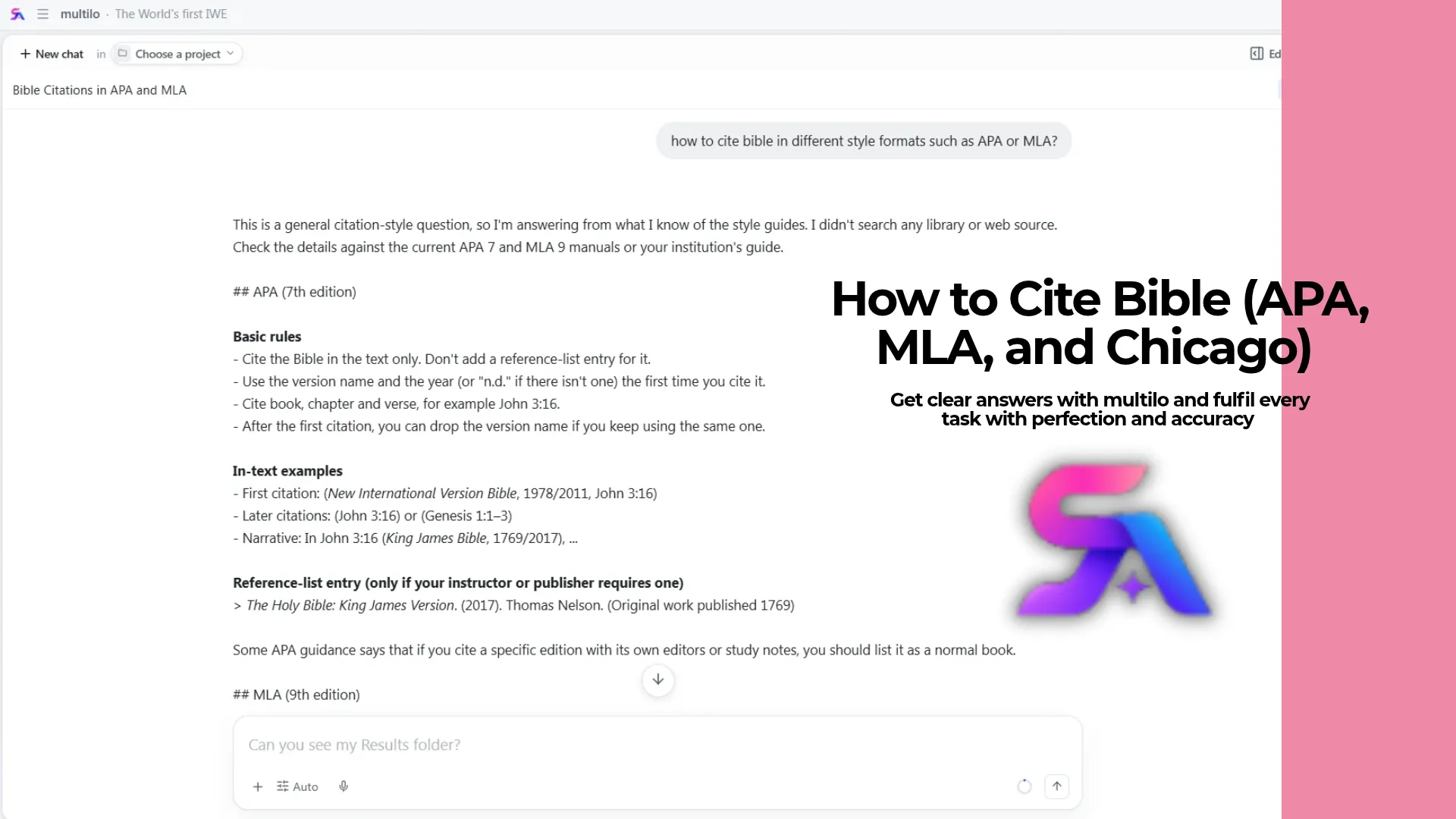
MLA core rules

Those who want to cite the Bible in MLA style often feel good because MLA style is very simple. MLA treats the Bible the same way as any other book. The only difference is that, in place of the author, the version name, the address of the book, the chapter, and the verse are given.

Important points are as follows:

  • The version you used: write its title in italics, like “The New Oxford Annotated Bible." However, the word “Bible” or the name of the Bible’s books should not be written in italics and should not be placed in inverted commas around them.

  • When adding first-time in-text citations in brackets, add the full name of the version. The citations come after this; add only the name of the book, chapter, and verse.

  • MLA puts a full stop between chapter and verse, like “Ps 23.1." Choose only one and use it entirely in your writing until your instructor tells you another style.

  • Inside parentheticals and citations, add abbreviations of the Bible’s books; however, write the full name in simple sentences.

In-text Citations and Writing Quotations (MLA)

To write anything from the Bible in MLA style is the same as quoting from any book. If the quotation is short, then write it in your sentence in inverted commas, and before adding a full stop at the end of the sentence, add a citation in brackets. for instance:

“The psalmist begins with a simple declaration: 'The Lord is my shepherd; I shall not want' (King James Bible, Ps. 23.1).”

  • When you give a quote again citing from the same version, then there is no need to add the version name; only write the book, chapter, and verse name: (Ps. 23.4)."

  • If a prose quotation is longer than 4 lines, then write it in a separate block. Start it on a new line, indent the full prose from the left side by half an inch, and do not use inverted commas. In this situation, parenthetical citations come after the full stop.

  • If verses are continuous, then add a dash between them: “(Ps, 23.1-3)”.

  • If verses are separate, then add a comma between them: “(John 3.16, 18).

  • Whatever version of the Bible you use, keep the spelling and punctuation the same while writing, and do not change it yourself.

Chicago (17th Edition): Notes, Abbreviations, and Practice

Core Rules of Chicago

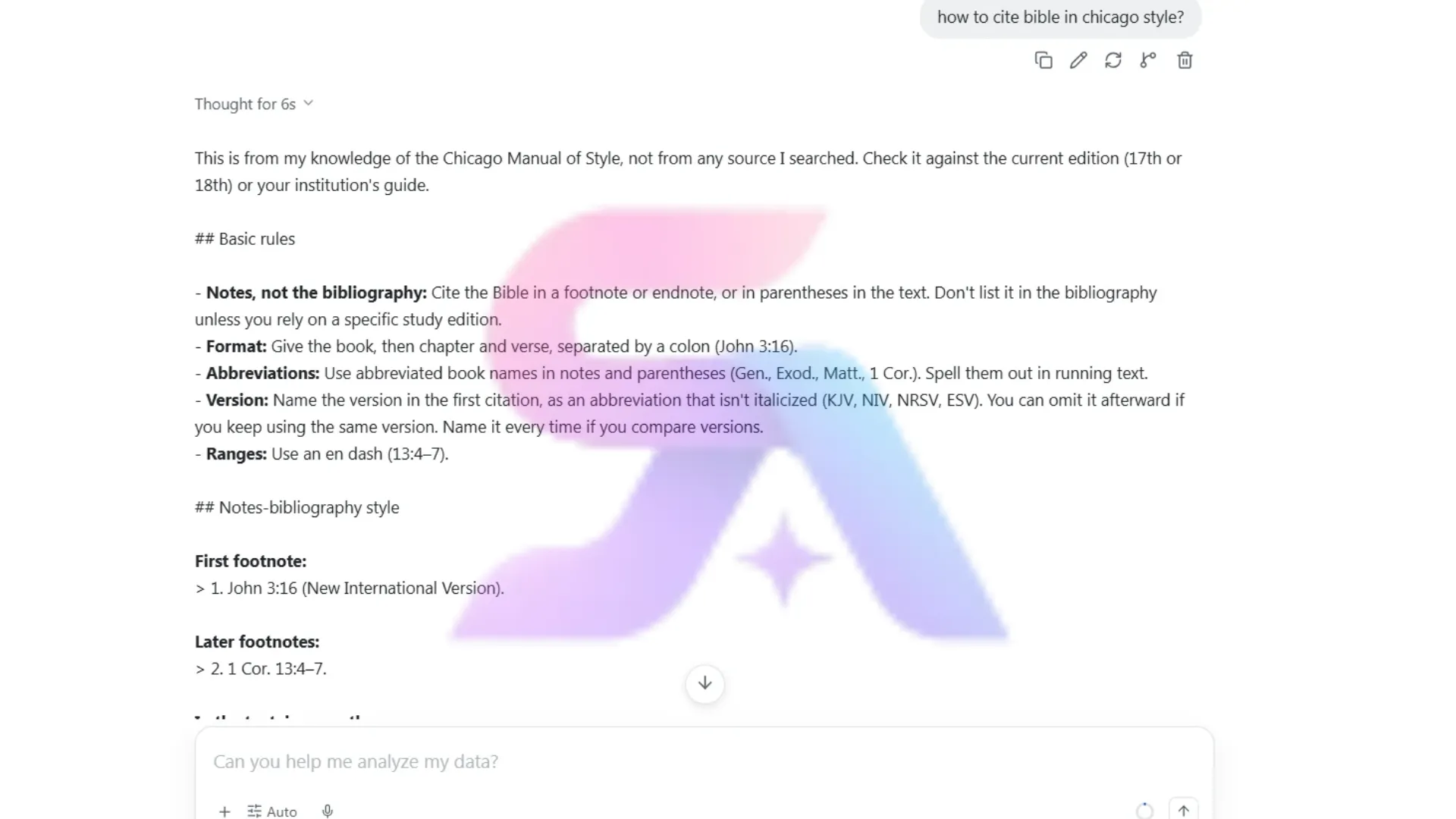
If you have to cite the Bible in Chicago style, then the first surprising thing is that often you don’t need to add it in the bibliography. Chicago style admits the Bible as such a reference, which can easily be handled in text and footnotes.

Key points are the following:

  • State the full name of the version in your first footnote or parenthetical, and afterwards use only abbreviations.

  • Use a colon between chapter and verse: “John 3:16”.

  • Inside parentheses and notes, use abbreviations of Chicago, and in your prose use the full name.

  • Never italicize the word “Bible” or the Bible's books.

  • Add a citation in the bibliography only if you used any Bible study or book in which the editor and publisher have additional notes or prose.

In-Text and Note Examples

First note: with the full name of the version

  1. “Ps. 23:1 (King James Version)”

Later note: with abbreviation of version

  1. “John 3:16 (KJV)”.

If you want to cite inside parentheses rather than a footnote, then after the quote write this way:

““Blessed are the peacemakers: for they shall be called the children of God” (Matt. 5:9 KJV).”

If you have to add Bible study to the bibliography, then write this way:

“Cogan, Michael D., ed. The New Oxford Annotated Bible. 5th ed. New York: Oxford University Press, 2018”.

If a citation is taken from the editor's own notes rather than from a true verse of the Bible, then cite it like a common book and add the page number:

  1. “Coogan, New Oxford Annotated Bible, [page Number]”.

Common Examples for Students

Use this table as a starting template and write your own selected Bible verses, versions, and editions by editing it.

Citation Format

In-text Citation

Full Reference

APA (7th ed.)

“(KJV, 1769/2017, Ps. 23:1)”

King James Bible. (2017). King James Bible Online.

MLA (9th ed.)

“(King James Bible, Ps. 23.1)”

The Holy Bible: King James Version.[Publisher name], [Publication year].

Chicago (17th ed.)

“Note: 1. Ps. 23:1 (KJV)”

Usually there is no need to give citations in the bibliography in standard editions of the Bible, but if You use any Study Bible or Annotated Edition only, and then add citations in the last reference list.

Handling Special Situations

Citing more than one citation

It is common practice to compare the same verse in essays and sermons by using different versions. Write the name of the version with every quotation. In the list of references or works cited, enter every version separately. The first time you use an abbreviation of a version, then explain it. Never mix up two different words or versions inside the same inverted commas.

Paraphrasing and Explanatory Translation

Some Bibles are written as a paraphrase rather than a translation. Like “The Message." Its author is “Eugene H. Peterson”. Therefore, it is treated like a common author in APA and Chicago style. If you want to explain any verse in your own words, then the rules are the same: the verse and version name are necessary.

Study Bibles and Commentaries

Focus on what you are citing. If you write the main text of the Bible, then cite the version. If you are citing the editor’s introduction or footnotes, then in actuality you are citing the editor. Therefore, in the list, the editor’s name and the title of the study Bibles are written. The citation of commentary on any book of the Bible is just like the ordinary author’s book.

Apocrypha and Deuterocanonical Books

Books like Tobit, Sirach, and Wisdom of Solomon are only found in special editions of the Bible. Always check whether it is included in the edition you have or not, and give a citation to only that edition, such as abbreviated names Wis., Sir., and Tob. The numbering in Catholic and Orthodox editions is different from Protestant editions; therefore, write the correct edition name.

Online Websites and Stable URLs

Opening the Bible from websites and apps is easy, but the content is continuously changing in them. When citing online, rather than search results, add a specific URL link of that version. Include the publisher or copyright holder's name given on the page. In APA and Chicago style, there is no need for an access date, while in MLA it is optional.

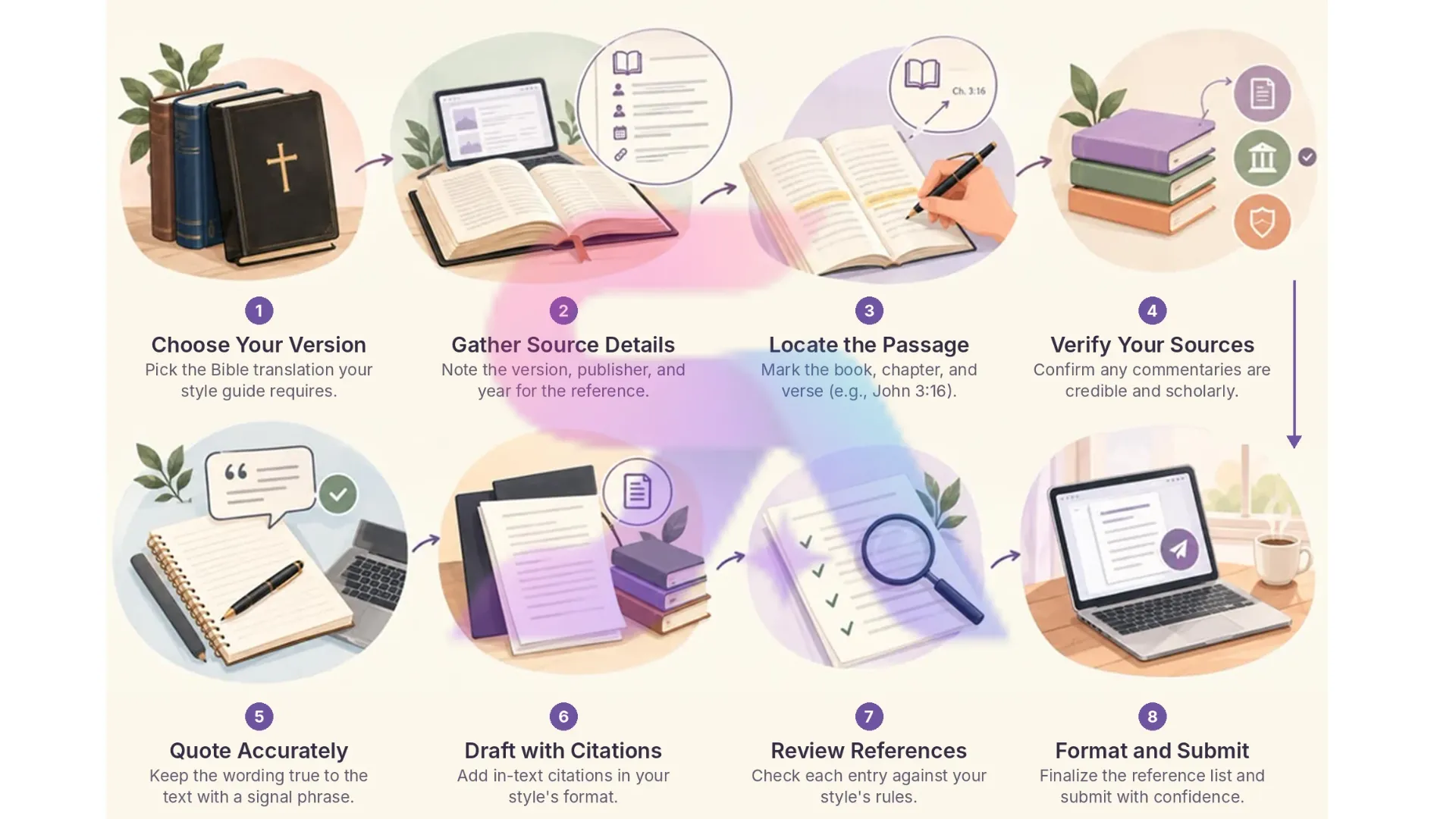
Workflow: From Research to Submission

citing-workflow-for-bible
  1. Select one version of the Bible at the start and use it throughout your writing, unless in your writing it is necessary to compare other versions.

  2. As you open the Bible, save all edition details by writing the name of the book, publisher, year, editor, and, if any, URL link.

  3. While taking quotations, keep the words, spelling, and punctuation the same, and beside this, write the name of the book, chapter, and verse number.

  4. Before making the draft, decide which style, like APA, MLA, or Chicago, you want to use, because instead of last moment, you decide on the correct formatting in time.

  5. For every quotation or anything you write yourself, give in-text citations.

  6. The edition details you saved; prepare your reference page or works cited on the last page.

  7. While analyzing your paper, check your references separately, and satisfy yourself that all abbreviations, punctuation, and versions are correct.

Common Mistakes and How to Avoid Them

  • Add the name of the version in your first citation and later on use abbreviations.

  • Do not use italics in the Bible or its book names. Only used in special editions or versions in APA or MLA style.

  • In place of page numbers, write the name of the book, chapter, or verse.

  • According to your selected style, choose a specific separator and use only it throughout your writing.

  • The versions you used, add them in your reference list one by one.

  • If anything is taken from the editor’s notes, then cite the editor and study Bible rather than the Bible.

  • Write abbreviations from a standard list and verify them from your instructor’s list.

Quick Decision Checklist

  • Which style did my instructor want me to use: APA, MLA, or Chicago?

  • Did I include the name of the version in my first citation?

  • Did I use the correct separator according to my style between chapter and verse?

  • Are all the versions I used included in the reference list?

  • Is it a present true verse of the Bible, or give a citation of footnotes of the Study Bible?

  • Are all quotations properly written, and are inverted commas and block format used?

How Multilo helps you cite the Bible

Citing Scripture correctly depends on the style you’re working in. APA, MLA, and Chicago each handle the translation or version, book, chapter, and verse differently, and it’s easy to slip on details like abbreviations or the first-citation format. Multilo takes that guesswork out. Its Citation Generator supports more than 30 citation styles, so you can switch to the one your professor or journal requires and have your Bible references formatted to match. And because Multilo is a full research workspace, you can check citations right inside your draft as you write, instead of fixing them at the end.

Frequently asked questions

Is there a different method for citing a whole book?

Yes, if you are discussing any full book of the Bible, like Jonah or Ruth, then write only the book name rather than the chapter or verse name. However, first, telling the version name is necessary. The chapter and verse numbers are only used in specific parts or verses.

Should small numbers of verses be used inside quotations?

In the printed Bible, the small numbers of verses written inside the text are not included in quotations. Rather, give only parenthetical citations so that your written thing looks clean and easy to read.

Does the same rule apply to a presentation or speech?

Yes, in slides and verbal conversation, the same rules are applied, which are used for any essay. Show the verse address and version in your notes, and add a complete reference on the last slide or handout.

Which version should I use for academic work?

First of all, consult with your instructor. If they have no specific recommendation, then at a practical level choose the most commonly used version, like NRSV or ESV. If historical or traditional words matter, then use the KJV and use it consistently throughout your writing.

Share this post

About the author