A Worked Outline Example
Here is how the template looks for a review on remote work and employee productivity:
I. Introduction
Why remote work matters now
Scope: empirical studies of knowledge workers published since 2015
Research question: What does research show about remote work and productivity, and what shapes that relationship?
II. Search strategy
Business and psychology databases, plus Google Scholar
Terms: “remote work,” “telework,” “productivity,” “performance”
Peer-reviewed empirical studies of knowledge-work roles only
III. Body
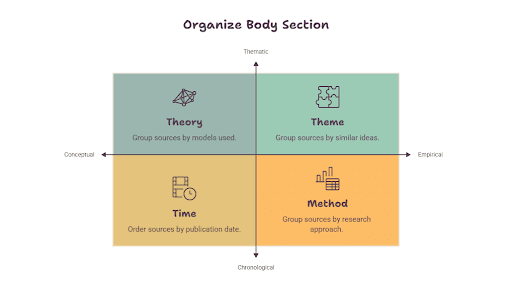
Theme 1: Productivity outcomes are mixed.Some studies find gains and others find losses, and self-reported results often differ from tracked output.
Theme 2: Job type, home workspace, and manager communication shape the results.
Theme 3: Most studies rely on self-reports over short periods,Which limits what we know about long-term effects.
IV. Conclusion
Each theme makes a claim rather than naming a topic. “Job type, home workspace, and manager communication shape the results” tells the reader exactly what the section will argue. “Remote Work” tells them nothing.
How Long Should Each Section Be?
Proportions matter more than page counts, and the balance is roughly the same whatever the document.
The body should take most of the space, around three quarters of the review. The introduction and conclusion together take most of the rest, with the conclusion usually the shorter of the two. The search strategy is brief wherever it appears, since it describes a process rather than making an argument.
If one body section is running at twice the length of the others, that is a structural signal rather than a writing problem, and the next section explains what it usually means.
Adapting the Templates for Your Field
Field | Outline changes | Matrix changes |
Health sciences | Detailed search strategy, often with a flow diagram of how studies were selected | Add an evidence strength or study quality column. |
Humanities | Often organized by period or school of thought, a formal search strategy is usually not needed. | Use the method column for the critical approach |
Stem | The review is often short and part of the paper’s introduction. | A slimmer matrix focused on findings and gaps |
Business and education | The full template works with small changes. | Standard columns work well |
As a rough guide, a short review might draw on 15–25 sources, a master’s chapter on 30–60, and a dissertation on 80 or more. You can usually stop when new sources stop adding anything new.
Common Mistakes to Avoid
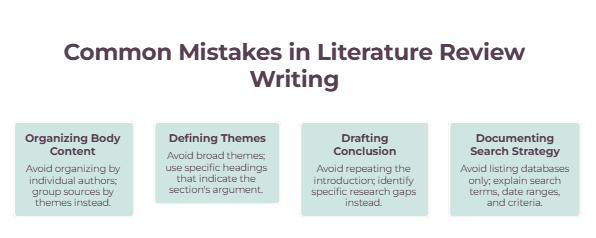
Organizing by author.One common mistake is organizing the body around individual authors instead of themes. If your review has one section for Smith, another for Jones, and another for Brown, it can feel like a list of summaries rather than a real review. Instead, group sources based on what they collectively show.
Themes that are too broad.Another mistake is choosing themes that are too broad. A heading like “Productivity” does not tell the reader what the section will argue. A more specific heading like “Factors that affect the productivity relationship” gives the section a clear direction.
A conclusion that repeats the introduction.A weak conclusion is another problem. repeating the introduction or saying that the review “examined the literature“ does not show what the research is still missing. Instead, identify the specific research gap that needs further attention.
A search strategy that is only a list of databases.Also, do not make the search strategy a list of databases. Explain the search terms, date range, and criteria you used to decide which sources to include or exclude. This gives readers a clearer idea of how you found and selected your sources.