How to Cite Legal and Government Documents (APA and MLA)

In short

Legal sources break the usual rules because they have no author and exist in several published forms. MLA builds an entry around the court or legislature and the version you read; APA puts the case name or law title first and points to the official report. This guide gives both formats for cases, laws, bills, reports, and constitutions.

Key takeaways

  • MLA cites the version you read; APA cites the official law. That single difference explains most of the formats.

  • The court is the author in MLA, so entries begin “United States, Supreme Court” rather than with a person’s name.

  • Case names are italicized in MLA entries and in your prose, but in APA only in the in-text citation, not the reference list.

  • One law can have three citations: the bill, the public law, and the code section. Cite the form you actually used.

  • Use the decision date, not the date a case was filed or argued.

  • APA needs no reference entry when you mention a constitution as a whole, only when you cite a specific provision.

Most students and researchers find it difficult to cite legal sources, as they do not follow the ordinary citation rules. Sometimes, you get frustrated when you have the case open in one tab, the MLA notebook in another, and the citation generator on the other hand is giving you something that looks completely wrong.

The source has a case name in clear text, but there is no author anywhere on the source, and also that specific law you cited appears in three different publications with different numbers. In this situation, nothing that you have learned about citing books or journal articles works. 

That’s because legal sources break the rules you normally rely on, and you might get confused that a court opinion has no byline and different style guides have different rules to cite. Once you know the clear difference, all these formats will become easy for you. This guide gives you the exact APA and MLA legal citation formats and shows you how ro cite legal documents in every form i.e., court cases, laws, bills, government reports, etc. with examples and mistakes that you should avoid.

Source

Style

Works Cited / Reference Format

In-Text

Court case

MLA 9

Government, Court. Case Name. Docket no., Date of decision. Website, URL.

(United States, Court of Appeals)

Supreme or highest court case

MLA 9

Country, Supreme Court. Case Name. Date of decision. Website, Publisher, URL.

(Canada, Supreme Court)

Law

MLA 9

Country, Legislature. Title of Law. Website, Publisher, URL.

(United Kingdom, Parliament)

Bill

MLA 9

Country, Legislature, Chamber. Title of Bill. Website, URL, Session, bill number, status.

(United States, Congress, House)

Government report

MLA 9

Title of Report. Agency, Date, URL.

(Shortened Title)

U.S. Constitution

APA 7

U.S. Const. art. #, § #.

(U.S. Const. art. #, § #)

There are two rules that apply everywhere.

  • In MLA, italicize case names but keep law and bill titles in regular (roman) type.

  • In APA, you need no reference entry when you mention the Constitution as a whole.

how to cite a legal case

Source

Style

Works Cited / Reference Format

In-Text

Court case

MLA 9

Government, Court. Case Name. Docket no., Date of decision. Website, URL.

(United States, Court of Appeals)

Supreme or highest court case

MLA 9

Country, Supreme Court. Case Name. Date of decision. Website, Publisher, URL.

(Canada, Supreme Court)

Law

MLA 9

Country, Legislature. Title of Law. Website, Publisher, URL.

(United Kingdom, Parliament)

Bill

MLA 9

Country, Legislature, Chamber. Title of Bill. Website, URL, Session, bill number, status.

(United States, Congress, House)

Government report

MLA 9

Title of Report. Agency, Date, URL.

(Shortened Title)

U.S. Constitution

APA 7

U.S. Const. art. #, § #.

(U.S. Const. art. #, § #)


There are two rules that apply everywhere.

  • In MLA, italicize case names but keep law and bill titles in regular (roman) type.

  • In APA, you need no reference entry when you mention the Constitution as a whole.

MLA: Cite the Version You Actually Used

In MLA, you cite the source where you read; however, other guides use legal writing, such as Bluebook, McGill Guide, or Aglc, usually ask you to cite the official publication. For example, in MLA, if you read a court decision on any legal information institute, you directly cite that website instead of going to the official publication. Moreover, if you used a scanned PDF for state reports, you can cite the book details instead. 

MLA gives you two options; you can choose one depending on the institute requirements and use the same method throughout your paper.

  • Standard method: In this method, list the government or court as the author and then follow the usual MLA format. This is the easier choice for humanities papers. 

  • Hybrid method: In this method, replace the author and title with the case name and legal citation, and then add where you found it. It can be useful for papers that cite many court cases.

On the other hand, APA follows legal citation rules more fairly, as it refers to the Bluebook for U.S. examples. For laws and cases from other countries, you should use the relevant local guide for citation. For in-text citation in APA style, it generally uses the case or law title with the year.

Basic Formatting Rules

  • Dates: MLA uses the day, month, and year, such as 26 June 2015. Most months are shortened, but May, June, and July are written out. APA generally uses the year.

  • URLs: MLA leaves out “https://” from URLs. APA may not require a URL for legal references, but when you include one, use the full page URL you actually used.

  • Access dates: In MLA, add the date you accessed a page if it has no publication date or is likely to change, such as a bill tracker or regularly updated law.

  • Hanging indent and order: Use a half-inch hanging indent for each entry. MLA entries are alphabetized by the first word, while APA legal references are generally organized by case name or law title.

How to Cite a Court Case in MLA

Knowing how to cite a legal case in MLA becomes easier when you know where the decision was made. For example, if the decision comes from a federal appeals district or state court, MLA follows the following format, while Supreme Court cases use a different approach, which is discussed separately. 

  • Template: Government, Name of Court. Case Name. Docket no. [number], Day Month Year of decision. Title of Website, URL.

  • State court example: [State] State, Court of Appeals. Case Name. Day Month Year. Website, URL. Unpublished opinion. 

Where to find each element

  • Government and court: you can find the court’s name at the top of the first page, so write the country for federal courts and the state or province for local courts, and then the full court’s name.

  • Case name: after naming the government and court, next comes the case name. You can use the names of the first party on each side joined by “v,” and you don’t need to write et al., first names, or extra parties involved. For example, “Authors Guild, Inc., et al. v. Google, Inc.” is written as Authors Guild v. Google, Inc. Also italicize the whole case name

  • Docket number: It refers to the court’s filing number that is printed near the case caption (No. 13-4829). It helps readers find lower-court decisions.

  • Date: Then write the date the court decides the case; that is usually written on the first page. It doesn’t include the argument or filing date. 

  • Container and URL: At the end, add the URL of the website where you read it.

Example: United States, Court of Appeals for the Second Circuit. Authors Guild v. Google, Inc. Docket no. 13-4829, 16 Oct. 2015. United States Court of Appeals for the Second Circuit, URL.                                                

  • In-Text Citations for Court Cases

Your in-text citation must match the first element of the Works Cited entry. For example,

  • (United States, Court of Appeals).

Moreover, if you want to specify the numbered paragraph of that case, add it at the end like  (United States, Court of Appeals, par. 12). Or, instead, you can add the name of the case in your sentence; for instance, “In Authors Guild v. Google, the Second Circuit held…” 

Common Mistakes

The following are the mistakes that you should avoid while citing the court case in MLA.

  • Leaving the case name in plain text—it should be italicized according to MLA 8 and 9 citation rules.

  • Listing a lawyer or judge as author—in legal citations, the court is considered the author unless you cite a separate dissent or concurrence.

  • Using the filing date—add only the decision date in the entry

How to Cite a Supreme Court Case in MLA

Knowing how to cite a Supreme Court case in MLA comes down to one question: where did you read it? The opinion stays the same, but the entry changes with your source.

Template: [Country], [Highest Court]. Case Name. Day Month Year of decision. Website, publisher, URL.

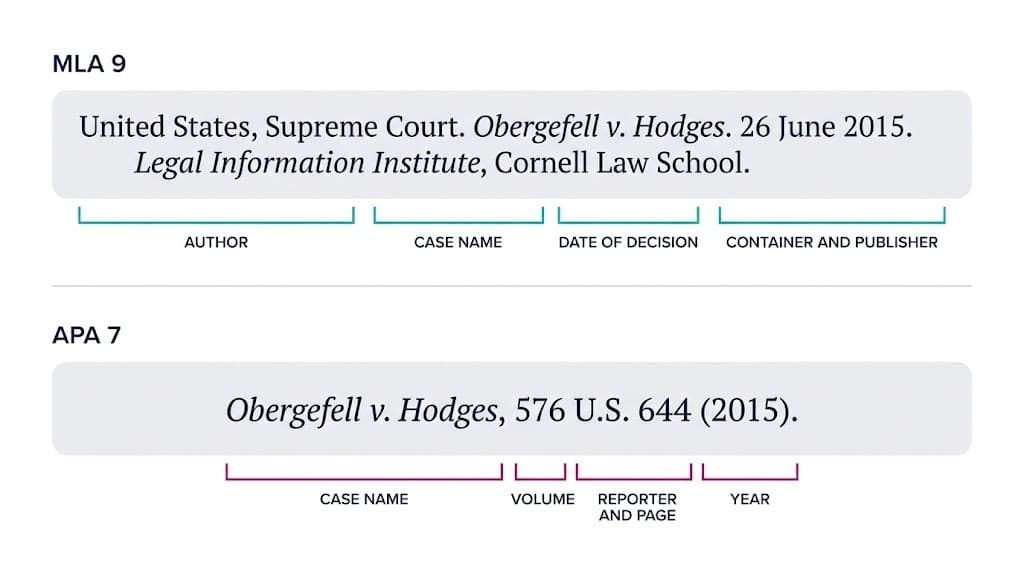
Example: United States, Supreme Court. Obergefell v. Hodges. 26 June 2015. Legal Information Institute, Cornell Law School, www.law.cornell.edu/supremecourt/text/14-556.

Supreme Court entries usually drop the docket number as the court and date identify the case. Also, italicize the site name and add the publisher when it differs.

When you read a scanned opinion from the Library of Congress or supremecourt.gov, the reporter becomes your first container and the website your second:

Template: [Country], [Highest Court]. Case Name. [Official Reporter], vol. [number], Day Month Year, pp. [first–last]. Website, URL. 

Example: United States, Supreme Court. Case Name. United States Reports, vol. [number], Day Month Year, pp. [first–last]. Library of Congress, URL.

For in-text citations, you can cite an exact page: (United States, Supreme Court 444).

Citing a Dissenting Opinion

If you quote only the dissent, the justice becomes the author, and a label follows: Roberts, John G. Dissenting opinion. Obergefell v. Hodges. To be clear, a dissent is not the court’s ruling, so attributing it to “the Supreme Court” misstates the law, so avoid that mistake.

Citing Several Supreme Court Cases in One Paper

Add a short case name when you cite several cases. Every entry begins “United States, Supreme Court,” so distinguish them as (United States, Supreme Court, Miranda)

Plus, when a case begins with a government party, such as Nlrb v. Yeshiva University, shorten it to the first non-government party (Yeshiva). For papers citing a dozen cases, the hybrid method is cleaner, since in-text citations shrink to (Miranda) or (Tinker).

How to Cite a Law in MLA

Federal laws can appear in different forms, and the same law can have several citations. You should use the one you actually read.

A Public Law

Use the public law version when you are discussing what Congress passed at a particular point in time. For example:

Template: [Country], [Legislature]. [Law Number]. [Official Statute Series], vol. [number], [year], pp. [first–last]. [Publisher or Website], [URL]. 

Example: United States, Congress. Public Law 103-3, Family and Medical Leave Act of 1993. United States Statutes at Large, vol. 107, 5 Feb. 1993. U.S. Government Publishing Office, [exact gov info URL].

In-text citation: United States, Congress

Note: the parenthetical always starts with the first elements of cited entry. If you used hybrid method and started the citation with Public Law 103-3, then your in-text citation will be “Public Law 103-3” and not “United States, Congress.“ Also the titles of laws are capitalized but never italicized or placed in quotation marks.

State Laws

For a state law, put the state legislature in the author position. Then give the name of the state code, followed by the chapter or section number:

[State] State Legislature. [Name of State Code]. Chapter #, section #. Website, URL.

The names of laws and acts are capitalized like titles, but they are not italicized or put in quotation marks. For example, write the Civil Rights Act, not the Civil Rights Act.

How to Cite a Bill in MLA

A bill is proposed legislation, so check its status on the legislature’s website before you cite it. So it is best to include the bill’s status, as the bill number alone doesn’t specify whether it is passed, rejected, or became the law.

Template: [Country], [Legislature], [Chamber]. Name of the Bill. Title of Container, URL. [Session], [bill number], [latest status and date].

Example (House): United States, Congress, House. Protecting the Right to Organize Act of 2021. Congress.gov, www.congress.gov/bill/117th-congress/house-bill/842. 117th Congress, 1st session, House Bill 842, passed House 9 Mar. 2021.

Example (state bill): [State] House of Representatives. House Bill [number]. [Legislature Website], URL. Accessed Day Month Year.

In-text citation: (United States, Congress, House)

In-text quotation: (United States, Congress, House, sec. 2)


APA keeps the legal citation almost unchanged, which is why an APA cite legal case entry looks like something a lawyer would write. There is no author element: the case name comes first.

Format:Name v. Name, Volume Reporter Page (Court Year).

Example: Obergefell v. Hodges, 576 U.S. 644 (2015)..

In-text:(Obergefell v. Hodges, 2015), or narratively, “In Obergefell v. Hodges (2015), the Court held…”

Three rules are specific to APA cases:

  • Case names flip. They are italicized in text but not in the reference list, the reverse of MLA.

  • Name the court unless it is the Supreme Court. “(2d Cir. 2015)” identifies the Second Circuit; U.S. Supreme Court entries omit the court, since only its decisions appear in the United States Reports.

  • Use three underscores when there is no page yet: 597 U.S. ___ (2022).

How to Cite the Constitution in APA

APA 7 follows the legal citation form for the Constitution: no URLs, no databases, and sometimes no reference entry at all. This is also the section to use when you need to know how to cite a legal act or a numbered statute rather than a court decision. 

Mentioning the Constitution as a Whole

For a general reference, such as “The Constitution established three branches of government,” name it in your sentence. No in-text citation or reference entry is needed.

Citing an Article, Amendment, Section, or Clause

Once a specific provision supports your argument, add a reference entry and an in-text citation:

Format:[Country or State] Const. art. [Roman numeral], § [Arabic numeral], cl. [Arabic numeral].

Example: U.S. Const. art. I, § 8.

U.S. Const. amend. XIV, § 1.

In-text:(U.S. Const. amend. XIV, § 1).

Abbreviations to Use

Part

Abbreviation

Numbering

Article

Art.

Roman (art. II)

Amendment

Amend.

Roman (amend. XIX)

Section

§

Arabic (§ 2)

Clause

Cl.

Arabic (cl. 3)

Preamble

Pmbl.

None

Nothing in a constitutional citation is italicized, and you add no year for provisions in force.

Here is how to cite legal documents in APA style with examples

Source

APA 7 format

Example

In-text format

Court case

Name v. Name, Volume Reporter Page (Court Year).

Obergefell v. Hodges, 576 U.S. 644 (2015).

(Name v. Name, Year)

Statute

Name of Act, Title Source § Section (Year).

Family and Medical Leave Act of 1993, 29 U.S.C. § 2601 et seq. (1993).

(Name of Act, Year)

Bill

Title, H.R. or S. [number], [#]th Cong. (Year). URL

Protecting the Right to Organize Act of 2021, H.R. 842, 117th Cong. (2021).

(Title, Year)

Congressional report or hearing

H.R. Rep. No. [#]-[#] (Year). URL

Title of hearing, [#]th Cong. (Year). URL

H.R. Rep. No. 117-89 (2021).

(H.R. Rep. No. [#]-[#], Year)

(Title of Hearing, Year)

Regulation or executive order

Title or Number, Volume C.F.R. § [#] (Year). URL

Exec. Order No. [#], 3 C.F.R. Page (Year). URL

Exec. Order No. 13,985, 3 C.F.R. 7009 (2021).

(Title or Number, Year)

(Exec. Order No. [#], Year)

Non-U.S. case

Follow that country’s legal guide (Oscola, McGill, Aglc).

Donoghue v Stevenson [1932] AC 562 (HL).

(Name v. Name, Year)

Note the case name: APA italicizes it in your text but not in the reference list, the reverse of what many students expect after learning MLA.


Frequently asked questions

How do you cite a court case in MLA 9?

List the government and court as author, then the italicized case name, the docket number (lower courts), the decision date, and the website and URL.

Is a court case name italicized in MLA?

Yes, in your paper and your Works Cited list. The MLA 7 plain-text rule no longer applies.

Does the U.S. Constitution go in the APA reference list?

Only when you cite a specific article, amendment, section, or clause. A general mention needs no citation.

Should I cite a bill or the law it became?

Cite the law if the bill was enacted, since that version has legal force. Cite the bill when you analyze the proposal, its debate, or a version that failed.

How do I cite a case I read about in a news article?

Cite the news article, not the case. Mention the case in your sentence in italics, but your Works Cited entry should describe the source you actually read.

How do you cite a case or statute in a legal memo?

Legal memos and briefs follow the Bluebook or your jurisdiction’s local rules, not MLA or APA, and cite to the official reporter with a pinpoint page. The formats in this guide are for academic writing.

Share this post

Related posts

Browse all posts