How to Write an Analytical Research Paper

Share this post

Staring at a blank document with an analytical research paper assignment due in a week? You're not alone. Every semester, thousands of students hit the same wall: they know how to summarize a source, but analyzing one feels like a completely different skill nobody actually taught them.

Here's the good news. Once you understand what an analytical research paper is actually asking you to do, the process stops feeling mysterious. It becomes a repeatable system—one you can use for any topic, in any class, for the rest of your academic life.

This guide walks through everything: what these papers are, why professors love assigning them, the exact steps to write one, a working example, common mistakes, and a checklist you can run through before you hit submit. Grab your coffee. Let's get into it.

What Is an Analytical Research Paper?

An analytical research paper is a piece of academic writing where you break a topic into parts, examine how those parts relate to one another, and build an argument based on evidence you've gathered. Unlike a summary, which retells what a source says, analysis asks you to interpret it — to explain why something happens, how different pieces connect, or what the deeper implications are.

Think of it this way: if a summary is describing the ingredients in a recipe, analysis is explaining why the chef chose those specific ingredients and how they work together to create the final dish.

What This Type of Paper Requires

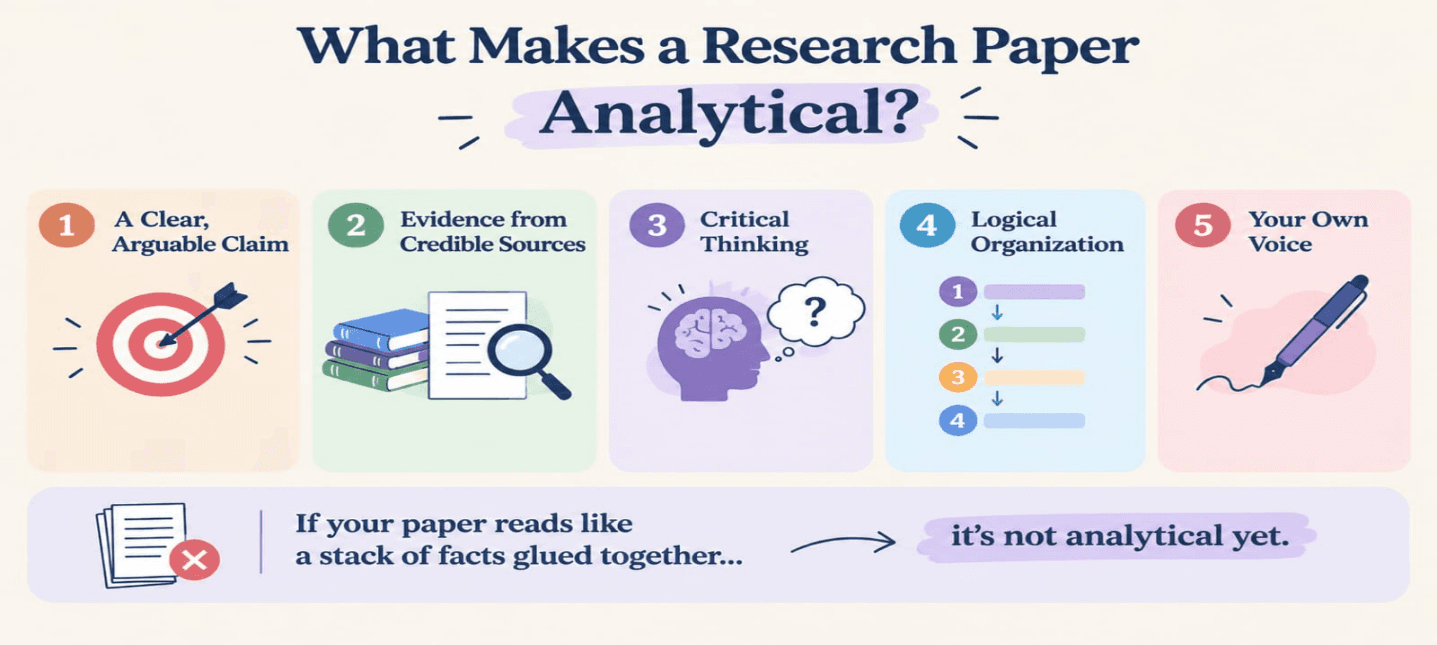
An analytical research paper demands a few things that a basic report doesn't:

  • A clear, arguable claim—not just a topic, but a specific position you're defending

  • Evidence from credible sources, properly cited and woven into your argument

  • Critical thinking, meaning you're constantly asking "so what?" about the facts you present

  • Logical organization, so each paragraph builds on the last

  • Your own voice, synthesizing other people's research rather than just listing it

If your paper reads like a stack of facts glued together, it's not analytical yet. It's a rough draft of a summary wearing an analytical paper's clothes.

Why Analytical Research Paper Matters

Professors assign these papers because the skill transfers far beyond the classroom. Analytical thinking is what lawyers use to build a case, what doctors use to diagnose a patient from overlapping symptoms, and what marketers use to figure out why a campaign flopped. Learning to dissect a topic, weigh evidence, and draw a defensible conclusion is one of the most practical academic skills you'll ever pick up — even if it doesn't feel that way at 1 a.m. the night before it's due.

There's also a quieter benefit that most students only notice years later: analytical writing trains you to hold two ideas in your head at once — the evidence in front of you and the bigger pattern it belongs to. That habit shows up again the first time you're asked to write a business case, interpret a quarterly report, or explain to a client why a strategy underperformed. The paper you're writing this week is, in a very real sense, practice for arguments you'll need to make for the rest of your career.

Analytical vs. Argumentative vs. Descriptive Writing

Students often mix these three up, and it's worth untangling them before you start drafting:

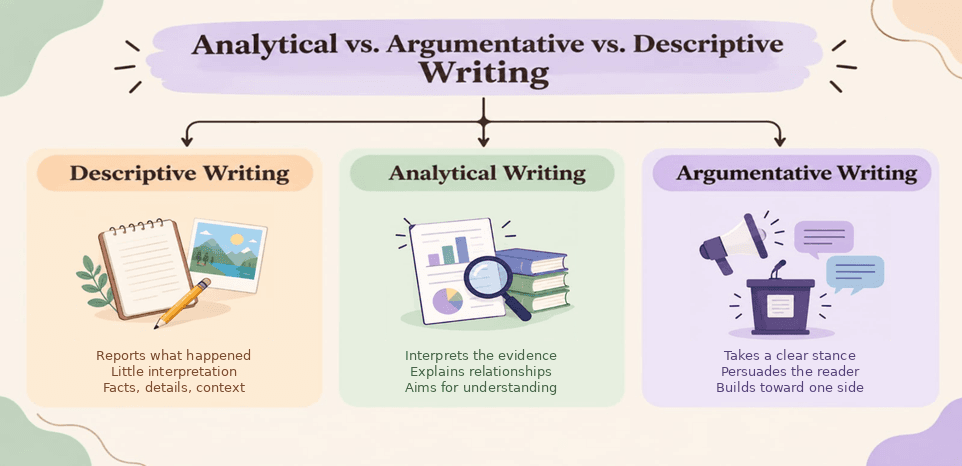
  • Descriptive writing simply reports what something is or what happened, with little interpretation attached

  • Argumentative writing takes a firm stance on a debatable issue and works to persuade the reader to agree

  • Analytical writing sits between the two—it interprets and explains relationships within a topic, and while it does require a clear claim, the goal is understanding rather than pure persuasion.

Knowing which mode your assignment calls for changes how you approach evidence. Descriptive papers report facts. Argumentative papers stack evidence toward one side. Analytical papers examine evidence from multiple angles before landing on a reasoned interpretation.

How-to-Write-an-Analytical-Research-Paper

Main Features of Analytical Research Papers

Every strong analytical paper, regardless of subject, shares a recognizable skeleton. Knowing this structure ahead of time makes drafting dramatically faster because you're not guessing where information belongs—you already have a home for it.

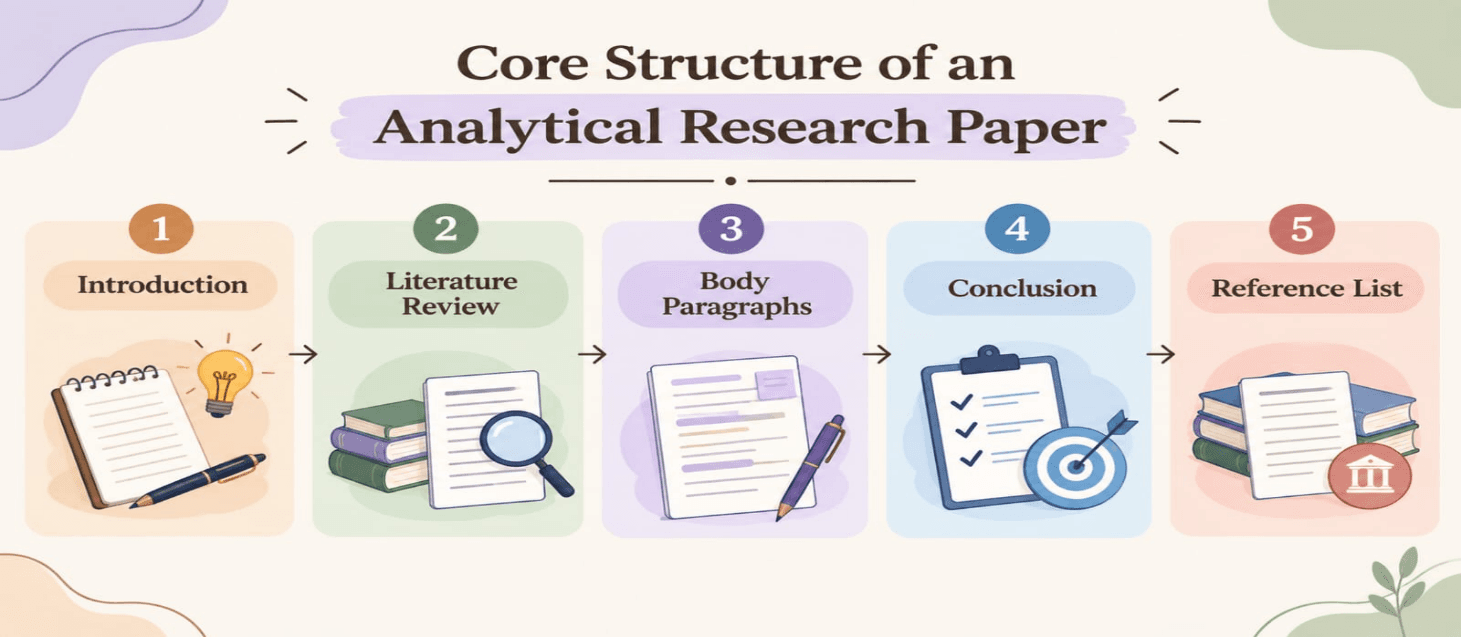
Core structure of an analytical research paper

  • Introduction: presents the topic, gives background, and ends with your thesis

  • Literature Review: shows what's already been said about your topic and where the gaps are

  • Body Paragraphs: each one develops a single point of analysis, backed by evidence

  • Conclusion: ties the analysis together and explains why it matters

  • Reference List: full citations for every source you used

Papers that skip a piece of this structure—say, jumping straight from introduction to conclusion without real body analysis—tend to feel thin, even when the writing itself is polished. Readers notice when the reasoning skips a step.

sample-of-analytical-research-paper

How to Write an Analytical Research Paper: A Detailed Guide

This is the part everyone actually came here for. Below is a step-by-step process that takes a paper from "I have no idea where to start" to "this is ready to submit."

Step 1: Choose a Strong, Analyzable Topic

Not every topic works for analysis. "Climate change" is too broad and too descriptive on its own. "How coastal city zoning laws have accelerated flood risk in the last decade"—that's analyzable, because it invites you to examine cause and effect, compare policies, and take a position.

A good topic usually has:

  • Enough published research to draw from

  • Room for genuine disagreement or multiple interpretations

  • A scope you can actually cover in the assigned word count

If you can't picture at least two people disagreeing about your topic, it's probably too descriptive to analyze.

Step 2: Research Widely and Take Organized Notes

This step gets rushed more than any other, and it shows. Pull from academic journals, books, and reputable databases rather than the first three links a search engine hands you. As you read, don't just highlight—write a one-sentence note in your own words explaining what each source contributes to your argument.

A simple system that works well:

1. Create a running document with a heading for each source.

2. Under each heading, jot the key claim, the evidence behind it, and a quick note on how it connects to your thesis.

3. Flag any sources that contradict each other—those tensions often make the richest analysis.

Step 3: Write a Clear Thesis Statement

Your thesis is the spine of the entire paper. It should state your specific claim, not just your topic. Compare these two:

  • Weak: "This paper will discuss social media's effect on teenagers."

  • Strong: "Heavy social media use during adolescence correlates with increased anxiety, primarily because of social comparison mechanisms built into platform design rather than screen time itself."

The second version tells the reader exactly what you're going to prove and hints at how you're going to prove it. Every paragraph that follows should trace back to this sentence.

Step 4: Create a Detailed Outline

Before you write a single body paragraph, map out your argument. List your main points in the order they'll appear, and under each one, note which sources will support it.

Why outlining helps you think more clearly: an outline forces you to spot weak points before they become weak paragraphs. If you can't fill in evidence under a bullet point, that's a sign the point needs more research—or needs to be cut entirely. Writers who skip this step often discover the gap halfway through a paragraph, which is a much more frustrating place to find it.

Step 5: Write Clear and Insightful Body Paragraphs

Each body paragraph should do four things, in roughly this order:

1. Open with a topic sentence stating the paragraph's specific point

2. Introduce evidence—a statistic, a quote, a study finding

3. Explain what that evidence actually means and how it supports your thesis

4. Connect back to your broader argument before moving to the next point

The explanation step is where most drafts fall short. Dropping in a quote and moving on isn't analysis—it's decoration. Spend at least two or three sentences unpacking why that evidence matters.

Step 6: Write a Literature Review That Synthesizes Information

A literature review isn't a list of "Source A said this, Source B said that." It's a synthesis—grouping sources by theme or perspective and showing how they relate. Notice where scholars agree, where they clash, and where nobody has looked closely yet. That last gap is often exactly where your own analysis can add something new.

Step 7: Write an Engaging Introduction and Conclusion

Ironically, many writers draft these two sections last, even though they appear first and last on the page. Your introduction should hook the reader with why the topic matters, then narrow down to your thesis. Your conclusion shouldn't just restate the thesis—it should explain the broader significance of what you found and, where relevant, suggest what questions remain open.

Step 8: Revise, Cite, and Proofread

Writing and editing are different jobs, so treat them separately. Read your draft out loud—awkward sentences reveal themselves fast when spoken. Check that every claim has a citation, that your citation style is consistent throughout, and that your reference list matches every in-text citation exactly. Then proofread one more time for grammar, because a strong argument loses credibility fast when it's riddled with typos.

Analytical Research Paper Format that Works

Formatting requirements vary by discipline, but most analytical papers follow a similar shape:

  • Font and spacing: typically 12-point font, double-spaced, with one-inch margins

  • Title page: paper title, your name, course, instructor, and date

  • Heading style: consistent use of APA, MLA, or Chicago, depending on what your instructor requires

  • Page length: usually 5–15 pages depending on the assignment, though shorter analytical essays can run 3–5 pages

  • In-text citations: placed immediately after the evidence they support, not bunched at the end of a paragraph

One formatting habit worth building early: match your citation style before you start writing, not after. Reformatting forty citations the night before a deadline is a special kind of misery.

A Professionally Written Research Paper Example

Seeing a short analytical paragraph in action often clarifies the concept faster than any explanation. Here's a compact sample built around a manageable claim:

Remote work arrangements, while often framed as a flexibility benefit, have measurably altered team communication patterns in ways that reduce spontaneous problem-solving. A 2023 workplace study found that informal, unplanned conversations—the kind that happen at a shared coffee machine—dropped by nearly 60% among fully remote teams compared to in-office counterparts. These unplanned exchanges are not simply social filler; they're often where cross-departmental knowledge gets shared before it becomes an official meeting agenda item. When that channel disappears, information tends to travel more slowly and through more formal, siloed routes. The result is not necessarily lower productivity on individual tasks but a measurable increase in duplicated work and missed cross-team opportunities—a cost that rarely shows up on a spreadsheet but shows up clearly in project retrospectives.

Notice what makes this analytical rather than descriptive: it doesn't just state a fact (communication dropped), it interprets the fact (this is why it matters) and connects it back to a broader claim.

Common Types of Analytical Papers Students Encounter

Analytical writing shows up under different names depending on the course, but the underlying skill is the same:

  • Analytical essays: shorter pieces focused on breaking down a single text, event, or concept.

  • Literary analysis papers: examining a novel, poem, or play for themes, symbolism, or structure.

  • Rhetorical analysis papers: dissecting how an author or speaker persuades their audience.

  • Comparative analysis papers: placing two subjects side by side to explore similarities and differences.

  • Data analysis reports: interpreting numerical findings rather than textual ones, common in social science and business courses.


Knowing which flavor you've been assigned helps you choose the right sources and structure from the start, instead of realizing halfway through that you built the wrong kind of argument.

Pro Tips from Academic Writers Who’ve Done It All

A few habits separate writers who consistently score well from those who scrape by:

  • Write your thesis on a sticky note and keep it visible while drafting—it's easy to drift off-topic across ten pages.

  • Read one strong published paper in your field before you start, purely to absorb its rhythm and structure.

  • Argue with yourself. Before finalizing a claim, write down the strongest counterargument and address it directly. This alone makes analysis feel less one-sided and far more credible.

  • Cut your favorite sentence. If a line exists purely because it sounds clever rather than because it advances the argument, it usually needs to go.

  • Leave 24 hours between finishing a draft and revising it. Fresh eyes catch what tired eyes miss

Basic Mistakes to Avoid in Analytical Papers

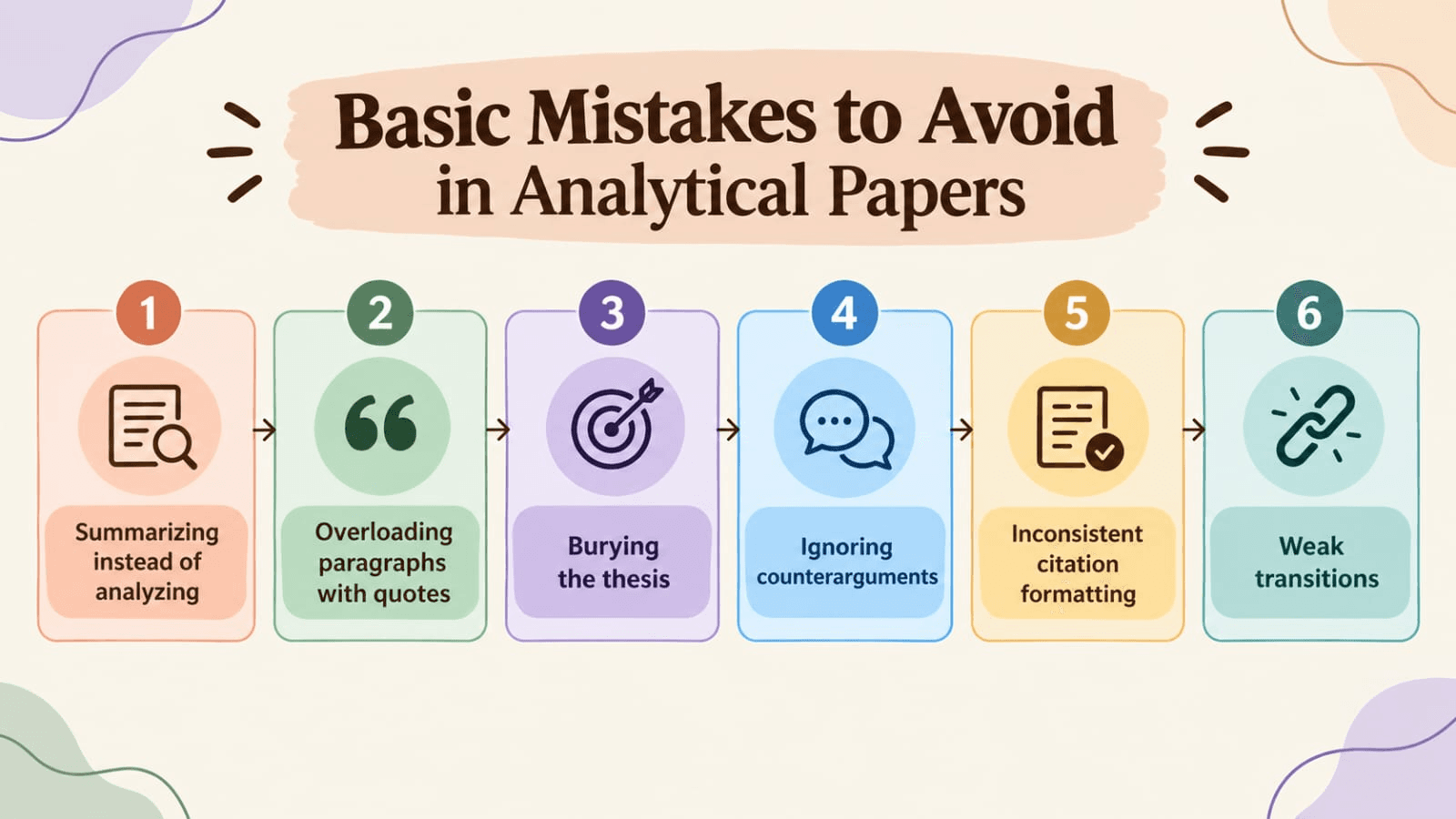
Even strong writers fall into these traps:

1. Summarizing instead of analyzing: describing what a source says without explaining its significance

2. Overloading paragraphs with quotes: evidence should support your voice, not replace it

3. Burying the thesis: if a reader can't find your claim by the end of the introduction, it's buried too deep

4. Ignoring counterarguments: pretending opposing views don't exist makes an argument look fragile, not strong

5. Inconsistent citation formatting: mixing MLA and APA styles within one paper is an easy, avoidable deduction

6. Weak transitions: jumping between points without connecting language makes the paper feel like a list rather than an argument

Pre-Submission Checklist for Analytical Research Papers

Run through this list before you submit:

  • Thesis statement is specific, arguable, and appears clearly in the introduction

  • Every body paragraph connects back to the thesis

  • Each piece of evidence is followed by analysis, not left to speak for itself

  • Literature review synthesizes sources rather than listing them one by one

  • Citation style is consistent throughout, including the reference list

  • Conclusion adds insight rather than simply repeating the introduction

  • Paper has been read aloud at least once for flow and clarity

Formatting matches your instructor's requirements (font, spacing, margins)

Tools and resources that make analytical writing easier

A handful of tools can genuinely speed up the process without doing the thinking for you:

  • Citation managers like Zotero or Mendeley to keep sources organized from day one

  • Grammar and clarity checkers for a final polish pass, used after your own edit, not instead of it

  • Outlining apps or even a simple spreadsheet to track which source supports which point

  • Your school's writing center and an outside reader almost always catch gaps you've stopped noticing

None of these replace careful thinking. They just remove friction so more of your energy goes toward the argument itself.

Conclusion

An analytical research paper isn't built in one sitting, and it isn't built by luck either. It's the sum of every small decision covered in this guide—a topic worth arguing about, a thesis that takes a real position, evidence that's explained rather than dumped on the page, and a structure that carries the reader from question to conclusion without any dead ends along the way.

If you remember nothing else from this guide, remember this: facts don't earn the grade; interpretation does. Every time you drop a statistic, a quote, or a finding into your draft, follow it with a sentence that answers, "Why does this matter?" That single habit is what separates an analytical paper from a summary wearing an analytical paper's clothes.

And if you're staring at a blank page right now, wondering where to start—start with a rough thesis. Not a perfect one. Write it down, let it guide your research, and let it evolve as you learn more about your topic. Writers who wait until the draft is "finished" to figure out their argument almost always end up with a paper that wanders, simply because there was never a spine to build around in the first place.

Draft messy. Revise deliberately. Trust the process, and the clarity will show up on the page—usually earlier than you expect.

Frequently asked questions

What is an analytical essay?

An analytical essay is a shorter piece of writing that breaks down a text, event, or idea into its component parts and explains how those parts create meaning or produce an effect, rather than simply summarizing the subject.

How do you start an analytical essay?

Open with a hook connected to your topic's significance, provide brief context, and end your introduction with a clear, specific thesis statement that previews your argument.

How many pages is a typical research paper?

Most academic research papers run 5–15 pages, though this varies widely by course level and instructor requirements—always check your assignment guidelines first.

What's the difference between an analytical and an argumentative paper?

An argumentative paper sets out to persuade the reader to adopt a specific position, often on a debatable issue. An analytical paper focuses more on breaking down and interpreting a topic, though it still requires a clear, defensible claim.

How do you write a strong analytical thesis statement?

State your specific claim, not just your topic, and hint at the reasoning behind it. A strong thesis tells the reader both what you're arguing and a glimpse of why.

What are good transition words for analytical essays?

Words and phrases like "consequently," "in contrast," "this suggests," "building on this," and "as a result" help connect your points logically rather than letting paragraphs sit as isolated blocks.

Share this post