Peer-Reviewed vs. Scholarly vs. Reliable: What’s The Difference?
These terms are related, but they should not be treated as identical.
A Peer-reviewed sourceHas undergone a particular review process involving subject experts.
A Scholarly sourceIs generally produced for an academic audience and often contains research, citations, and detailed evidence.
A Reliable sourceIs information that is appropriate and trustworthy for the specific purpose for which you are using it.
A source can be useful without being peer reviewed. For example, an official government webpage may provide authoritative statistics but is not necessarily a peer-reviewed publication.
This is why source evaluation should consider more than one factor.
How can you tell if an article is peer reviewed?
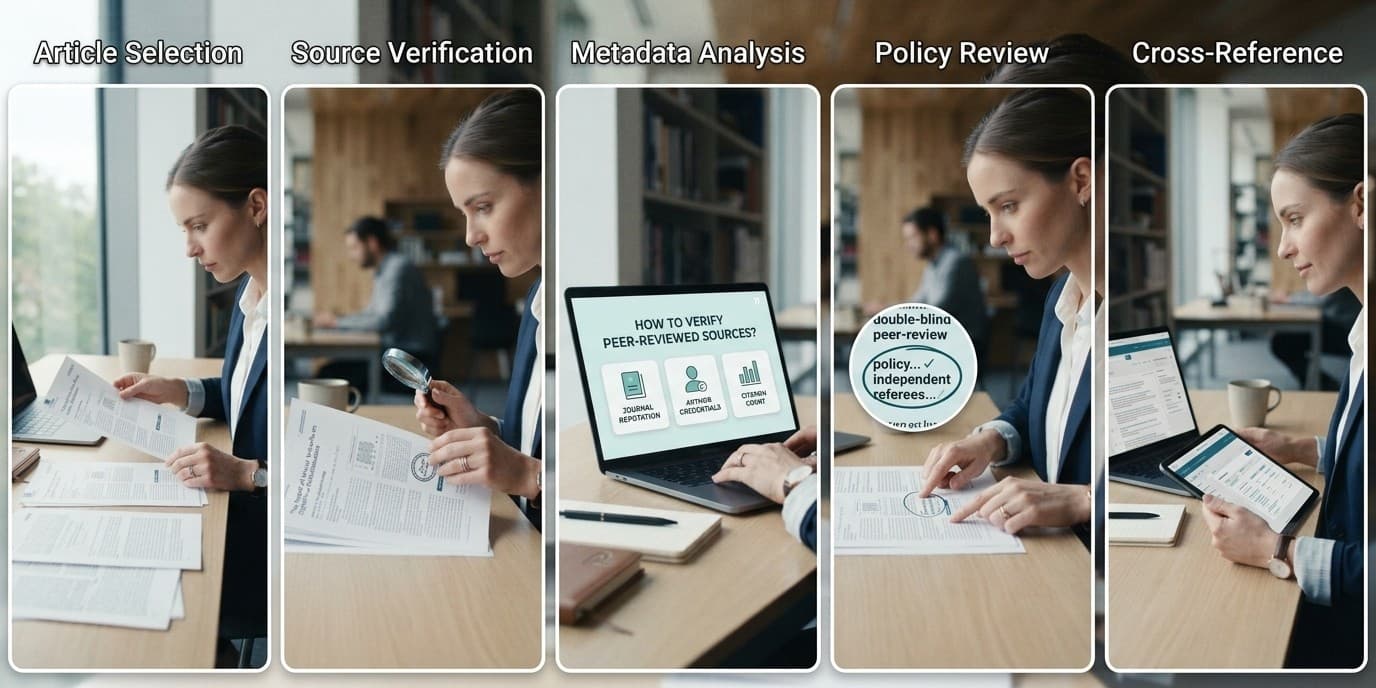
There is no single method that works for every article. The most reliable approach is to check several pieces of information rather than relying on the appearance of the webpage or PDF.
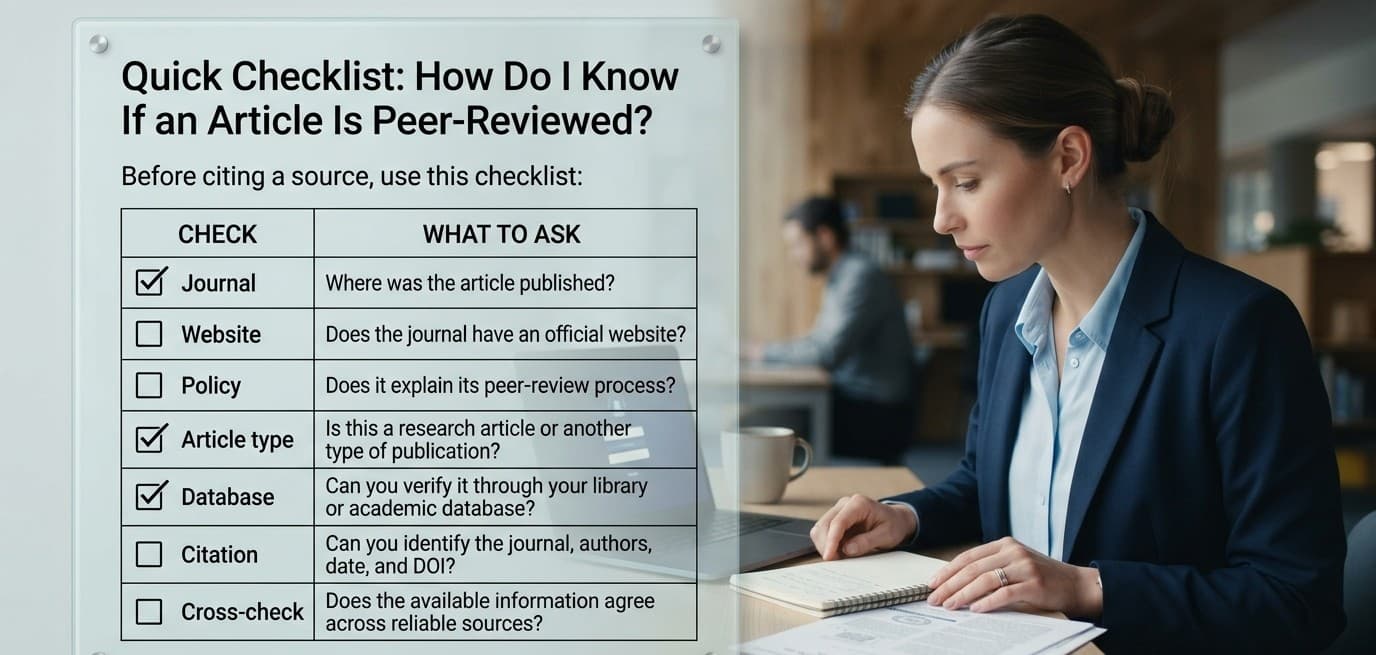
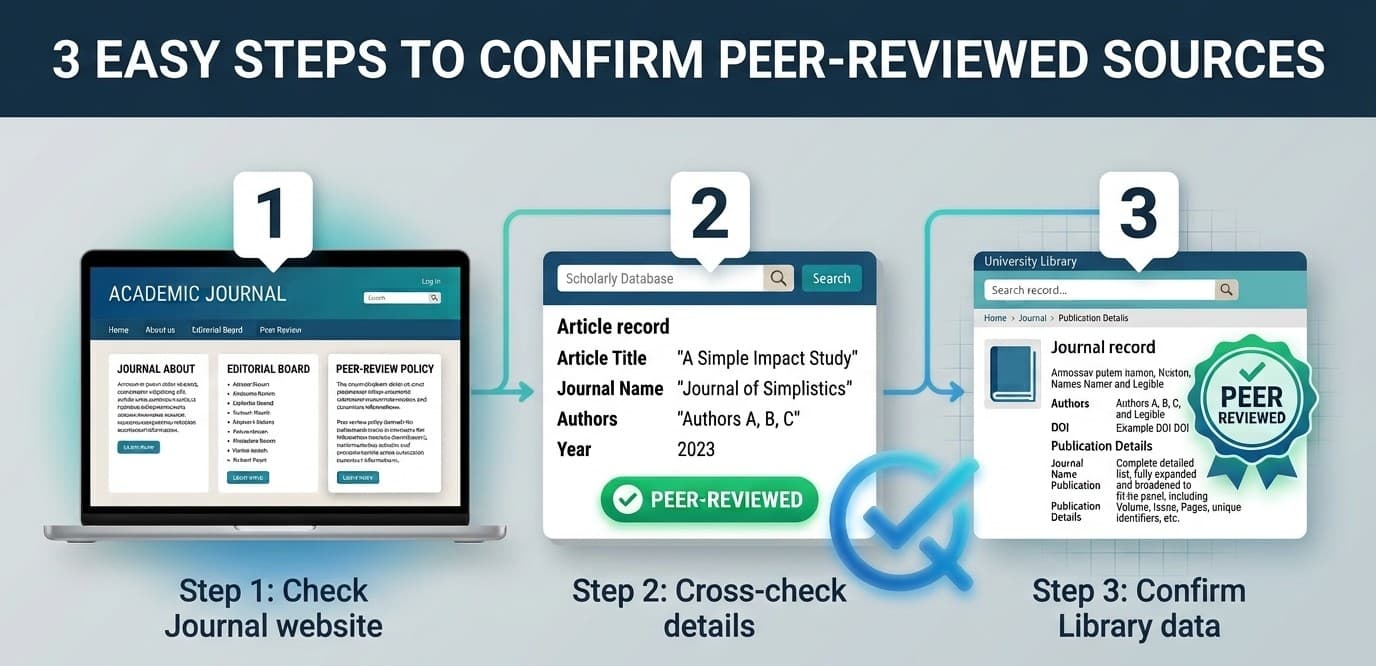
If you are asking, “How do I know if something is peer reviewed?“Start with these checks:
Step 1: Identify the journal and the publication details
Start with the article itself. Find the journal name, and be careful not to confuse the journal title with the article title. On the first page of a research paper you will usually find the article title, the author names, the journal information, and the publication details.
Look for:
Those last three dates are more useful than they look. A gap of several months between the date a manuscript was received and the date it was accepted, especially with a revision date in between, is a sign that the article went through review and revision rather than straight to publication.
Step 2: Read the journal’s peer-review policy
Search for the journal by its exact title and go to its official website. This is the most useful check available, because you are getting information from the publication itself rather than from a third party.
Look for pages such as About the journal, Editorial policy, Peer review, Instructions for authors, Publication ethics, or Editorial process. A journal should state how submitted manuscripts are evaluated, including:
Who reviews submitted manuscripts
Whether reviewers are experts in the subject
Whether reviewers and authors know each other’s identities
How revisions are handled
How editorial decisions are made
While you are on the site, check for a named editorial board, information about manuscript submission, publication ethics information, and a clear statement of the journal’s scope. None of these features proves that every article is peer-reviewed, but together they tell you a lot about how the publication operates.
Additionally, if the journal states that research manuscripts are evaluated by independent experts before publication, that is strong evidence of peer review.
Step 3: Confirm the type of article you are using
A peer-reviewed journal does not peer review everything it publishes. Editorials, book reviews, letters, commentaries, news items, and interviews usually follow a different editorial process.
Original research articles and review articles are normally peer reviewed. Opinion and news content usually is not. If the article type is not labeled, its structure is a good clue: a research article typically includes a methods section, results, and a reference list.
Step 4: Verify through a library database
Search for the journal or article in a database provided by your university or library. Databases such as Jstor, EBSCOhost, ProQuest, and Scopus allow you to filter results by publication type or by scholarly and peer-reviewed status.
Two tools are worth knowing specifically:
Ulrichsweb (Ulrich’s Periodicals Directory)Is the standard library resource for checking whether a journal is refereed. Most university libraries subscribe to it, and it is the closest thing to a genuine peer-review checker.
The Directory of Open Access Journals (Doaj)Requires journals to operate a review process before it will list them, which makes it useful for open-access sources.
It helps to understand how a database defines its filters rather than treating a label as proof on its own.
Step 5: Ask a librarian if you are still unsure
Academic librarians verify publication status as part of their work and can usually answer in minutes what might take you an hour. For an important assignment, this is the fastest way to get a definitive answer.