What Is The Central Idea Of A Text? (With Examples)

Have you ever finished reading an article or academic passage and understood every individual sentence but still struggled to explain what the text was really about?

The problem really comes from confusing the topic with the central idea. The topic tells you what a text discusses, while the central idea explains the main point the author wants readers to understand about that topic.

Knowing how to identify the central idea makes it easier to analyze research articles, literature reviews, academic arguments, speeches, and other forms of writing. In this guide, you will learn what a central idea is, how to identify it efficiently, how to write a strong central idea statement, and how to distinguish it from related concepts such as the topic and main idea.

What Is A Central Idea?

In stories, articles, speeches, and poems, there is one main point that connects the information. This main point is called the central idea. Understanding the central idea helps readers understand what the author is actually trying to communicate. Most texts develop one overarching message or idea, although longer and more complex texts may develop several related central ideas.

Unlike a topic which names the subject being discussed, a central idea explains what the author is saying about that subject.

For example, Imagine a student who struggles with physics but practices every evening, asks questions of teachers in class, and eventually improves. Here the central idea could be:

Consistent practice and active effort can help students improve their understanding of difficult subjects.

The text contains details about homework, teachers, practice, and tests, but these details support the same idea.

How Does the Central Idea Appear in a Text?

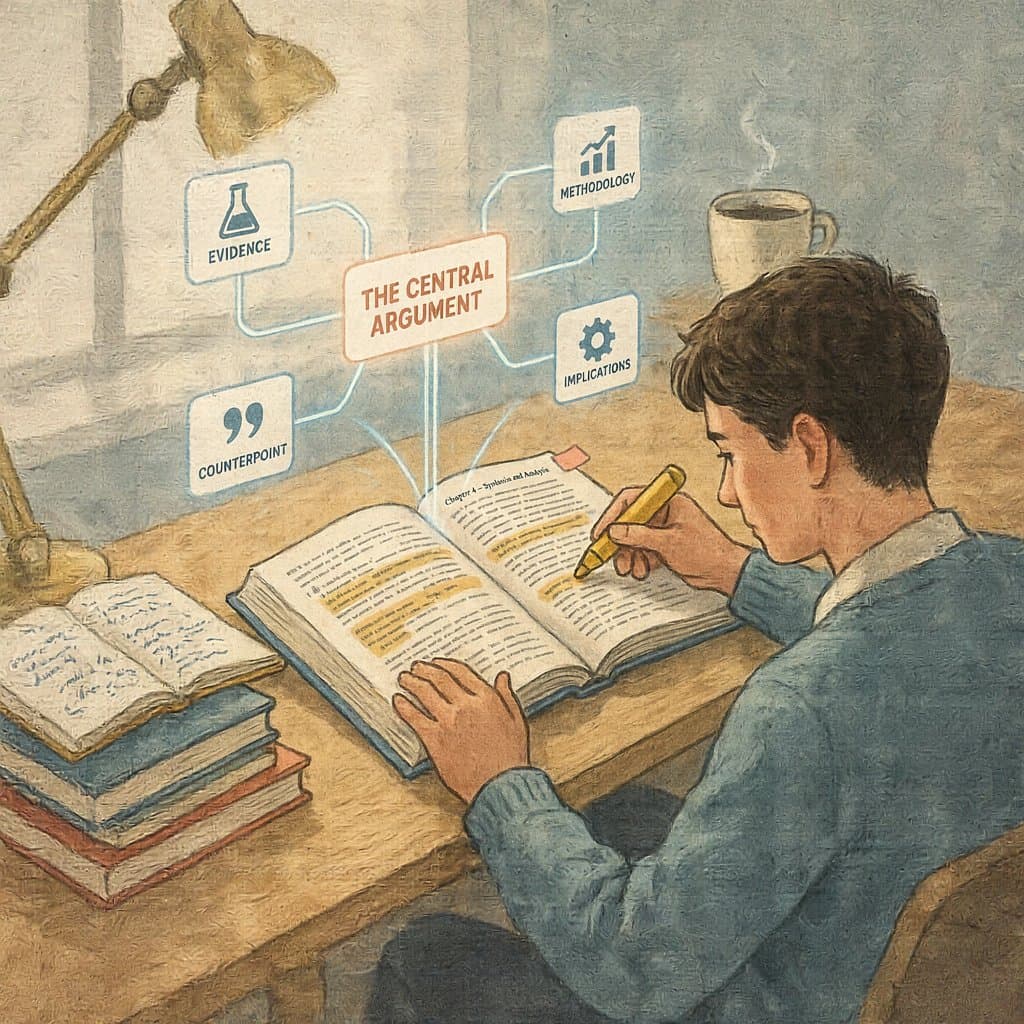
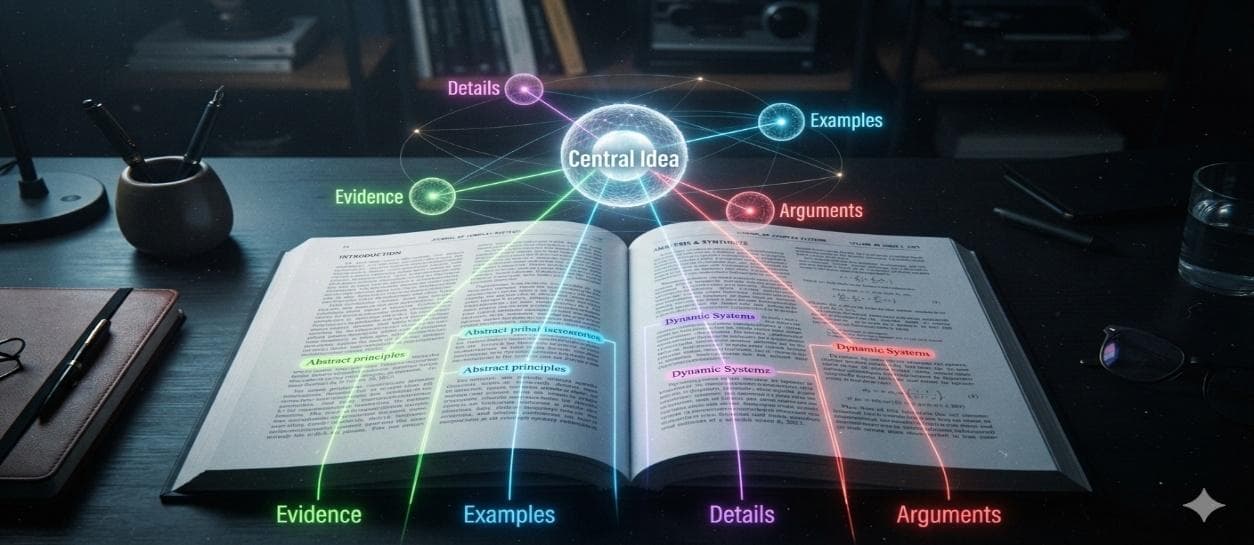
The central idea does not always appear as one exact sentence in the text. The central idea may be:

  • Directly stated

  • Implied through supported evidence

  • Developed across several paragraphs

  • Presented through an argument or conclusion

A useful way to understand the central idea is to ask, “What is this text trying to tell me?”

For example:

Imagine a research article examining whether remote work affects employee productivity. The article may discuss surveys, productivity metrics, and employee interviews across several sections. Although each section presents different evidence, the central idea could be that remote work can improve productivity when employees have appropriate communication systems and defined responsibilities.

What Is A Central Idea Statement?

A central idea statement expresses the overall message of a text in a clear sentence. It should be broad enough to cover the important parts of a text but specific enough to communicate the author’s main point.

For example:

  • Weak statement:

“Students”

  • Better central idea statement:

“Students can improve their academic performance by developing consistent study habits.“

How to Find the Central Idea of a Text?

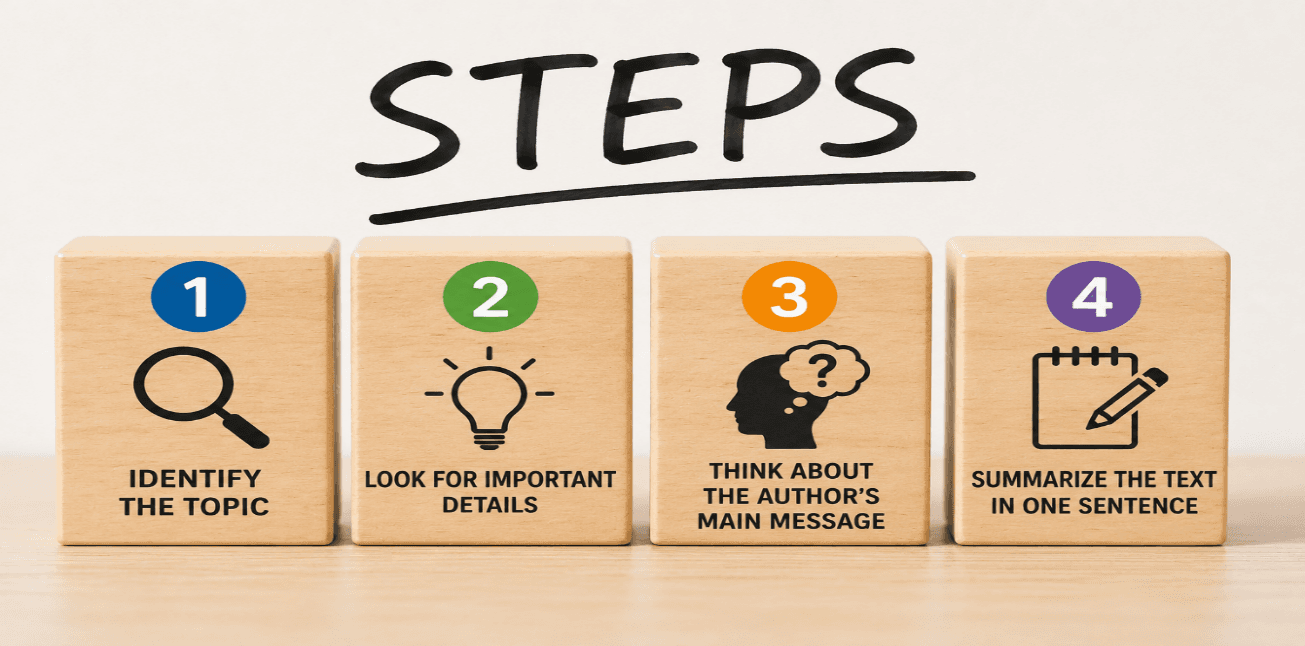
There are a few steps you need to follow to find the central idea when reading a story, article, speech, or passage

Step 1: Identify the topic

First, understand what the text is about. Start by determining the subject the author discusses most consistently. Look at the title, introduction, headings, repeated terms, and the subjects of individual paragraphs. A topic is usually a word or short phrase, such as Remote work, academic integrity, or climate policy.It does not explain what the author is saying about that subject.

Ask yourself:

  • Who or what is the text discussing?

  • What subject appears throughout the text?

  • What is the author focusing on?

For example: if a passage discusses plastic waste, recycling, and environmental pollution, the topic may be about plastic pollution. So you need to determine what the author is saying about the topic.

Step 2: Look for important details in the text.

Once you know the topic, examine the information the author uses to develop it. Pay attention to evidence, examples, explanations, statistics, comparisons, and arguments that appear repeatedly or receive significant attention. These details matter because they reveal what the author wants readers to understand about the topic. A single example may be supporting information, while several related examples can point toward the broader central idea.

Ask yourself:

  • Which idea is repeated over and over again?

  • What facts are mainly emphasized?

  • What examples does the author provide?

  • Which information seems more important?

These details can help you understand and reveal the central idea.

Step 3: Think about the author’s main message.

After examining the evidence, ask what conclusion or message connects those details.

Consider:

  • What point does the author repeatedly emphasize?

  • What does the evidence collectively demonstrate?

  • What does the author want the reader to understand?

  • How does the conclusion relate to the earlier discussion?

This step is important because the central idea is not a collection of details. It is the broader point that those details work together to develop.

Step 4: Summarize the text in one sentence.

Try expressing the author’s main point in one clear sentence. A strong central idea statement should explain both the subject and what the author communicates about that subject.

For example:

Topic: remote work

Too broad:Remote work is becoming more common.

Strong central idea:

Remote work can improve employee productivity when organizations provide effective communication systems and clear performance expectations.

The second statement gives the topic of remote work and also explains the author’s specific point about it.

Central Idea Examples

Here are some examples for better understanding the central idea. Examples show how a reader can identify the central idea from different types of texts.

Central idea example in a literature review

A literature review examines studies on social media and academic performance. Rather than focusing on one individual study, it compares findings across multiple researchers. The central idea could be that existing research suggests a relationship between social media use and academic performance, although the strength and direction of that relationship vary by usage patterns and study design.

Central idea example in a scientific text

A scientific text explains how rising temperatures affect freshwater ecosystems. Its central idea may be that increasing temperatures can disrupt freshwater ecosystems by altering species distribution, oxygen levels, and biological processes.
Central idea example in a research article

For example:

A research article examines how artificial intelligence tools affect academic research workflows. After discussing researchers’ survey, time savings, limitations, and accuracy concerns, the central idea may be that AI tools can improve research efficiency when researchers use them alongside human verification and critical evaluation.

Central idea example in a speech

In a speech, the central idea is the main message the speaker wants the audience to understand or remember.

Example: Imagine a speech encouraging students to read more books. The speaker discusses vocabulary, knowledge, and critical thinking.

The central idea is:

Regular reading helps students develop better knowledge and important thinking skills.

Central idea example in a poem or quatrain

Finding the central idea in a poem is more challenging because poems may use symbolism, imagery, and figurative language.

Central Idea vs. Main Idea: What’s The Difference?

These terms are used interchangeably. However, there can be a useful distinction between them.

Central idea

Main idea

Expresses the broader message or concept developed by a text

Usually describes the primary point of a particular paragraph, section, or passage

Connects multiple supporting ideas

Focuses on the main point of a specific part

May reflect the author’s overall message

Often summarizes what a section is mainly about

Can develop across an entire text

Can change from one section to another

How to write a good central idea statement?

A good central idea statement should be

  • Clear:The reader should understand it easily.

  • Concise:Avoid unnecessary information.

  • Broad enough:It should cover the important parts of the text.

  • Specific enough: It should communicate an actual message.

  • Supported by the text: The important details should provide evidence for it.

  • Written in your own words: Avoid copying a sentence from the source.

Central idea sentence examples:

Topic: Teamwork

Central idea: Working together helps people solve difficult problems more effectively.

Topic: Time management

Central idea: Effective time management can help students balance academic responsibilities with other activities.

How to tell if you found the right central idea?

The following questions can help.

  • Does it cover the whole text? It should not describe only one paragraph or example, but the whole text

  • Does it go beyond the topic? “Artificial intelligence” is a topic.

“Artificial intelligence can improve research efficiency when used with human oversight” is a central idea.

  • Is it supported by the text?

The author’s evidence should support your statement.

  • Is it specific without being too narrow?

It should capture the overall message without focusing on one isolated detail.

Frequently asked questions

What is the central idea statement?

A central idea statement is a concise sentence that expresses the main idea developed by a text. It should be specific enough to communicate the author’s point but broad enough to represent the text as a whole. For example, instead of writing “the article discusses renewable energy,” a stronger statement would explain what the article argues or demonstrates about renewable energy.

What is the difference between topic and central idea?

A topic is the general subject a text discusses, while the central idea explains the main point the author makes about that subject. For example, artificial intelligence in education can be the topic, while AI can support personalized learning when educators use it alongside appropriate human oversight is a central idea. The topic tells you what the text is about; the central idea tells you what the author wants you to understand about it.

Can a text have more than one central idea?

Yes. A longer or more complex text can develop several related central ideas, particularly when it covers multiple aspects of a subject. However, these ideas are usually connected to an overarching message or argument. When analyzing a text, distinguish between the main central ideas that connect the overall discussion and the smaller ideas developed in individual sections or paragraphs.

Is the central idea always written directly in the sentence?

No. Sometimes the author states the central idea explicitly, such as in a thesis statement or topic sentence. In other cases, the reader must infer it by examining repeated ideas, supporting evidence, examples, arguments, and the conclusion. This is especially common in analytical, literary, and research-based writing, where the overall message may develop gradually across the text.

How do you find the central idea of a passage?

Identify the topic, note the important details, look for repeated ideas, consider the author’s purpose, and summarize the message in your own words.